
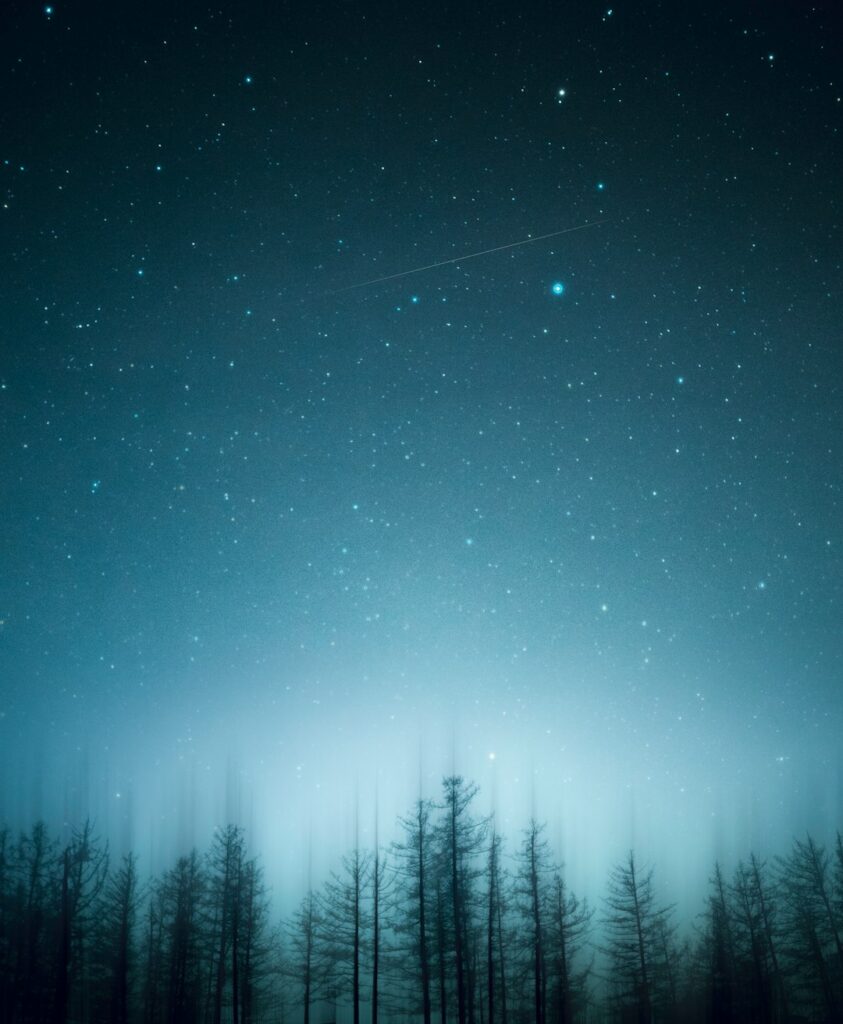
On a genuinely dark night, far from streetlights, the unaided human eye can pick out several thousand individual stars — and the faint band of the Milky Way becomes a visible arch of our own galaxy seen edge-on. You need no equipment at all to reach the Andromeda Galaxy, 2.5 million light-years away and the most distant object most people will ever see without optics. This is Guide № 008 in The Love Space Guide series.
Get the Full Collectible Guide (Free PDF)
How to Stargaze Without a Telescope — in a beautifully designed, printable booklet. The Love Space Guide № 008.
Let Your Eyes Do the Work First
The single most useful piece of stargazing “equipment” is already in your head, but it needs time to switch modes. In darkness the eye shifts from cone-based colour vision to rod-based night vision, and full dark adaptation takes roughly 20 to 30 minutes. The catch is that a single glance at a phone screen resets much of that progress in an instant. This is why experienced observers use a dim red light to read charts: red wavelengths interfere far less with the rods, letting you keep your hard-won sensitivity.
A second trick costs nothing: averted vision. The centre of your retina is packed with colour-sensitive cones but relatively few rods, so very faint objects actually vanish when you stare straight at them. Look slightly to the side of a dim star or galaxy and it brightens, because its light falls on the more rod-dense edge of your vision. Astronomers have used this for centuries, and it is the difference between seeing the Andromeda Galaxy as a smudge and not seeing it at all.
Find Truly Dark Sky
Light pollution, not cloud, is what defeats most would-be stargazers. The standard way to describe sky quality is the Bortle scale, a nine-point ranking published in Sky & Telescope in 2001 by amateur astronomer John Bortle, running from Class 1 (pristine wilderness sky) to Class 9 (inner-city). In a Class 8 or 9 urban sky you may see only a few dozen of the brightest stars; under a Class 1 or 2 sky the number climbs into the thousands and the Milky Way casts faint shadows.
To escape the glow you do not need to own land in the desert. DarkSky International certifies Dark Sky Parks, Reserves and Sanctuaries worldwide specifically for their protected night skies, and many are free public land. Before you drive out, it is worth checking a cloud-cover forecast — tools like Clear Outside give hour-by-hour predictions for astronomy. As a rule, the further you can get from the orange dome of a town, the more the sky repays you.
Learn the Signposts, Not Every Star
You do not memorise the sky star by star; you learn a handful of asterisms — recognisable patterns — and star-hop from them. The Big Dipper (part of Ursa Major) is the classic anchor: the two stars at the end of its bowl point straight to Polaris, the North Star, which marks true north and barely moves all night. In summer the Summer Triangle of Vega, Deneb and Altair dominates the overhead sky; in winter Orion’s three-star belt is unmistakable and leads down to Sirius, the brightest star in the night sky.
Free planetarium software makes this far easier than the old paper charts. Stellarium is a widely used open-source program (with a browser version) that shows exactly what is above you for your location and time, and apps such as SkySafari let you hold a phone up to identify what you are looking at — just switch to night mode so the screen glows red. The constellation boundaries themselves are officially fixed: the International Astronomical Union defined the modern 88 constellations in 1922.
Planets, the Space Station and Shooting Stars
Some of the best naked-eye targets are not stars at all. Venus, Jupiter, Mars and Saturn are all visible without optics when they are well placed, and there is a reliable way to tell a planet from a star: stars twinkle (an effect called scintillation caused by our turbulent atmosphere), while planets shine with a steadier light because they appear as tiny discs rather than points. Venus is often bright enough to be mistaken for an aircraft.
The International Space Station is the third-brightest object in the night sky after the Sun and Moon, and it is simply reflecting sunlight as it passes overhead at around 28,000 km/h. NASA’s Spot the Station service tells you exactly when it will cross your sky. Meteor showers are the other great free show — the Perseids peak around mid-August and the Geminids around mid-December, both producing dozens of meteors an hour under dark skies. The American Meteor Society and the International Meteor Organization publish annual calendars of peak dates. For any of these, the darker the Moon the better, so aim for the nights around a new Moon.
A Few Things That Actually Help
Comfort keeps you outside long enough to see anything. A reclining chair or a blanket on the ground spares your neck, warm layers matter even in summer because you are standing still, and your eyes do more work than any gadget. If you want to go a step further, a cheap pair of ordinary binoculars — not a telescope — transforms the Moon’s craters, the moons of Jupiter and dense star fields, and they are far easier to aim than a telescope.
If you would rather have expert company, public observatories run free or low-cost viewing nights. The Griffith Observatory in Los Angeles offers free public telescope sessions, and the historic Royal Observatory Greenwich in London — home of the Prime Meridian — runs astronomy events and planetarium shows. NASA also publishes monthly “What’s Up” skywatching guides that flag the best naked-eye sights.
Myths Worth Retiring
Myth: You need a telescope to see anything worthwhile. In truth, the Milky Way, five planets, every meteor shower, the Moon’s major features, the Andromeda Galaxy and the Orion Nebula are all visible to the unaided eye under a dark enough sky. A telescope adds detail; it is not the price of admission.
Myth: Stars twinkle because they are dying or flickering. The twinkling happens entirely in our own atmosphere — moving pockets of air bend the starlight before it reaches your eye. From above the atmosphere, stars shine perfectly steadily.
Myth: A clear, bright full-Moon night is ideal for stargazing. A full Moon is one of the worst times to look for faint stars and the Milky Way, because it floods the sky with light. The nights around a new Moon are far better for seeing deep-sky objects.
Frequently Asked Questions
Where is the best place to stargaze if I live in a city?
Even a short drive helps enormously, because light pollution drops off quickly with distance from the urban core. Look for a certified Dark Sky Place through DarkSky International, or simply head to high ground or open countryside away from the town’s glow, and give your eyes at least 20 minutes to adjust once you arrive.
What is the single best night to go out?
A clear night within a few days of a new Moon, ideally coinciding with a meteor shower peak such as the Perseids in August or the Geminids in December. Check an astronomy cloud forecast first, since clear air matters more than warm weather.
Do I need an app, or can I learn the sky on paper?
Either works. A free program like Stellarium shows precisely what is overhead for your time and place and is the fastest way to learn, but a simple paper planisphere under a red light is a durable, battery-free alternative that many observers still prefer.
More The Love Space Guides
The Love Space Guide is a numbered series — one tightly focused subject at a time, each with its own downloadable collectible edition. Guide № 001 is The Apollo 11 Moon Landing, Guide № 002 is How the International Space Station Actually Works, Guide № 003 is The Voyager Golden Record, Guide № 004 is Why Rockets Launch From the Equator, Guide № 005 is The Mars Rovers, Guide № 006 is What Astronauts Actually Eat, Guide № 007 is The Hubble Space Telescope, This is Guide № 008. More editions are on the way.
🚀 Join Love Space
Every week, get hidden stories, local secrets, and travel inspiration from people who live and love it.