
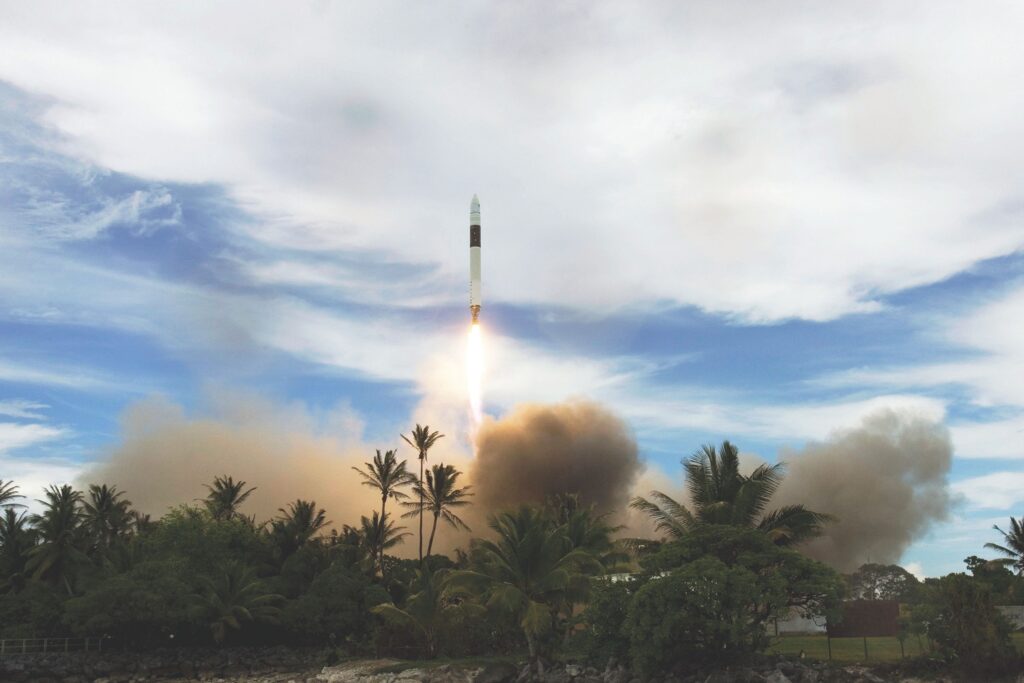
Stand on the equator and you are already moving east at roughly 1,670 kilometres per hour, carried by the planet’s spin — and a rocket sitting on the pad there gets that speed for free the moment it lifts off. That single fact shapes where some of the world’s busiest spaceports were built, from Europe’s launch site in French Guiana to the geography every mission planner studies before a satellite ever leaves the ground. This is Guide № 004 in The Love Space Guide series.
Get the Full Collectible Guide (Free PDF)
Why Rockets Launch From the Equator — in a beautifully designed, printable booklet. The Love Space Guide № 004.
The Spin of the Earth Does Part of the Work
Earth turns once on its axis every day, and because the planet is widest at the equator, points there travel the greatest distance in 24 hours — about 465 metres per second relative to the centre of the planet. A rocket launched toward the east is effectively given this velocity as a head start. Since reaching low Earth orbit requires a horizontal speed of roughly 7.8 kilometres per second, that head start is a small but genuinely useful fraction of the total, and every bit of speed the planet donates is speed the engines do not have to produce.
The further you move toward the poles, the smaller this effect becomes, because those points trace a tighter circle each day. At the latitude of Cape Canaveral, Florida (about 28.5° north), the rotational boost drops to around 408 metres per second. At a pole, it vanishes entirely. This is why nearly all orbital launches head east, working with the spin rather than against it.
Why Geostationary Satellites Love the Equator
The biggest advantage of an equatorial launch site is not really about raw speed — it is about geometry. A satellite’s orbital inclination (the angle its path makes with the equator) cannot be lower than the latitude of the site it launched from without an expensive mid-flight correction. Many of the most valuable satellites, especially communications and weather satellites in geostationary orbit, need to sit directly above the equator at an inclination of zero degrees so they appear fixed in the sky.
Launching from close to the equator means a rocket is nearly lined up with that target orbit from the start. A site at higher latitude has to perform a “plane change” manoeuvre to tilt its orbit down toward the equator, and plane changes are among the most fuel-hungry moves in spaceflight. Starting near zero latitude trims that cost, which is why Europe’s Spaceport at Kourou in French Guiana, sitting only about 5° north of the equator, is prized for launching heavy communications satellites.
Not Every Rocket Goes East — or Equatorial
The equator is ideal for equatorial and geostationary orbits, but it is a poor choice for others. Satellites that need to pass over the entire planet — Earth-observation, reconnaissance, and many weather spacecraft — use polar or Sun-synchronous orbits, flying roughly north-to-south. For those, the equator offers no rotational bonus at all, and sites at higher or more flexible latitudes can work just as well.
Geography and safety also override the textbook ideal. Rockets must launch over open water or empty land so that spent stages fall somewhere harmless, which is why many launch sites sit on east-facing coastlines. Russia’s historic Baikonur Cosmodrome sits at about 46° north in Kazakhstan, far from the equator, because it was chosen during the Cold War for remoteness and secrecy rather than for orbital mechanics.
The Famous Equatorial Spaceports
A handful of launch sites sit close enough to the equator to make the geography matter. Kourou in French Guiana, operated for European missions, is among the closest at about 5° north. India’s main spaceport at Sriharikota lies near 13° north on the Bay of Bengal, and the United States launches from Cape Canaveral and the Kennedy Space Center in Florida at about 28.5° north — not equatorial, but far enough south to benefit from a solid eastward boost over the Atlantic.
There have even been efforts to launch from the equator itself. The Sea Launch venture, active in the 2000s, floated a converted oil platform to a spot in the Pacific Ocean on the equator so rockets could extract the maximum possible rotational speed before heading to geostationary orbit. It was an elegant demonstration of the principle, even though commercial and financial troubles eventually grounded the project.
How Much Fuel Does the Equator Actually Save?
The savings are real but modest, and easy to overstate. The roughly 465 metres per second from Earth’s rotation is only about six percent of the speed needed for low Earth orbit, so the equator does not magically make spaceflight cheap. Its larger value shows up in reduced plane-change costs for geostationary missions, where avoiding that correction can free up meaningful payload capacity or extend a satellite’s working life.
For that reason, launch-site latitude is one factor among many — balanced against safe flight paths over water, proximity to manufacturing and transport, weather, political control, and the specific orbit a mission needs. The equator is an advantage, not a requirement, which is why the world’s spaceports are scattered across a wide band of latitudes rather than crowded onto a single line.
Myths Worth Retiring
Myth: The equator is closer to space, so rockets have less distance to climb. Space begins at roughly the same altitude everywhere — the commonly cited Kármán line is about 100 kilometres up regardless of latitude. The equatorial bulge actually puts the ground slightly farther from Earth’s centre, and in any case the hard part of reaching orbit is sideways speed, not altitude.
Myth: Every rocket launches from the equator. Most do not. Polar and Sun-synchronous missions gain nothing from equatorial rotation, and major spaceports like Baikonur operate far from the equator for reasons of history, safety, and national control.
Myth: The rotational boost is so large it is the whole reason rockets reach orbit. It contributes only a small share of the required orbital velocity. Engines still do the overwhelming majority of the work; the spin simply gives eastward launches a helpful nudge.
Frequently Asked Questions
Why do rockets launch toward the east?
Because Earth rotates from west to east, launching in the same direction adds the planet’s surface speed to the rocket’s own. Heading east means the engines can produce less of the total velocity needed to reach orbit, saving fuel on most missions.
Does the equator really save a lot of fuel?
It helps, but modestly. The rotational head start is around 465 metres per second, a small fraction of orbital speed. The bigger benefit is for geostationary satellites, which need an equatorial orbit and avoid a costly course correction when launched from near the equator.
Which spaceport is closest to the equator?
Among major active sites, Europe’s Spaceport at Kourou in French Guiana is one of the closest, at roughly 5° north. The Sea Launch project went further in the 2000s by launching from a floating platform positioned directly on the equator in the Pacific Ocean.
More The Love Space Guides
The Love Space Guide is a numbered series — one tightly focused subject at a time, each with its own downloadable collectible edition. Guide № 001 is The Apollo 11 Moon Landing, Guide № 002 is How the International Space Station Actually Works, Guide № 003 is The Voyager Golden Record, This is Guide № 004. More editions are on the way.
🚀 Join Love Space
Every week, get hidden stories, local secrets, and travel inspiration from people who live and love it.