
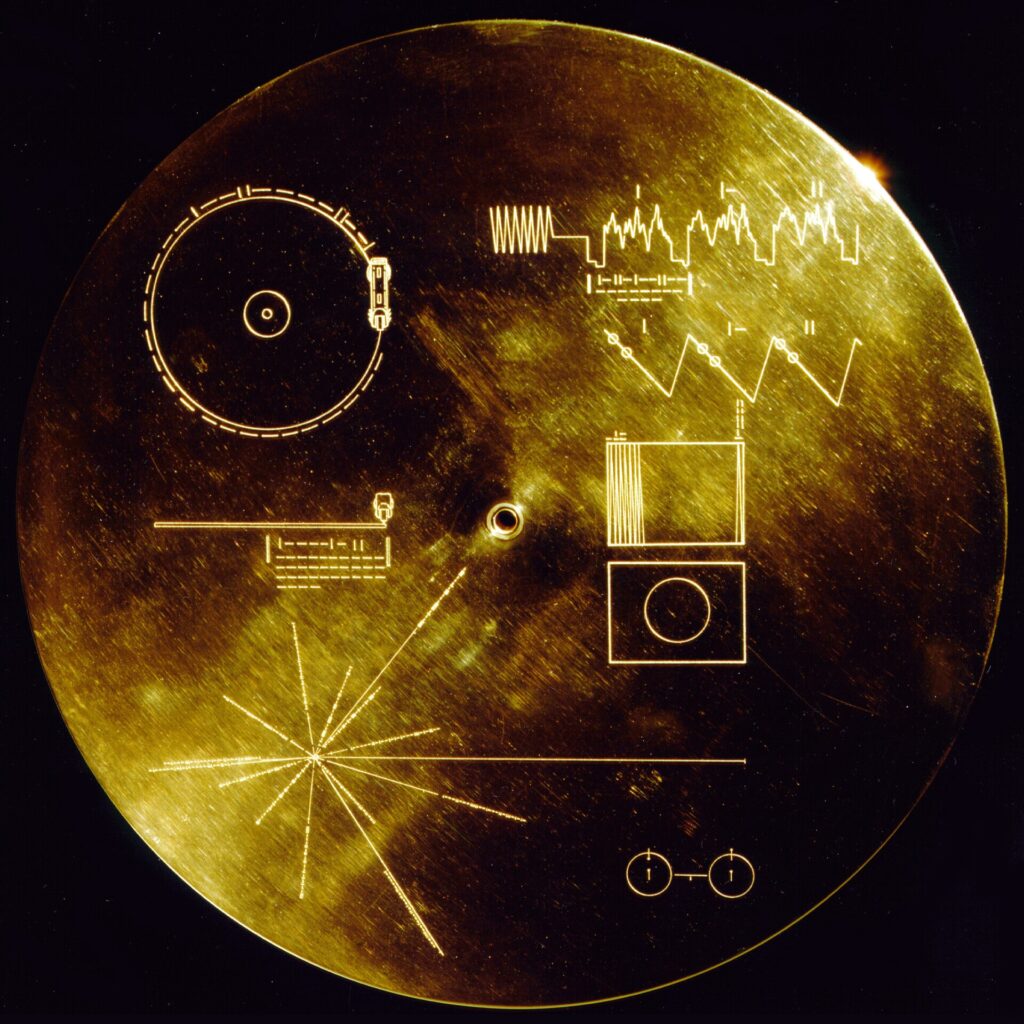
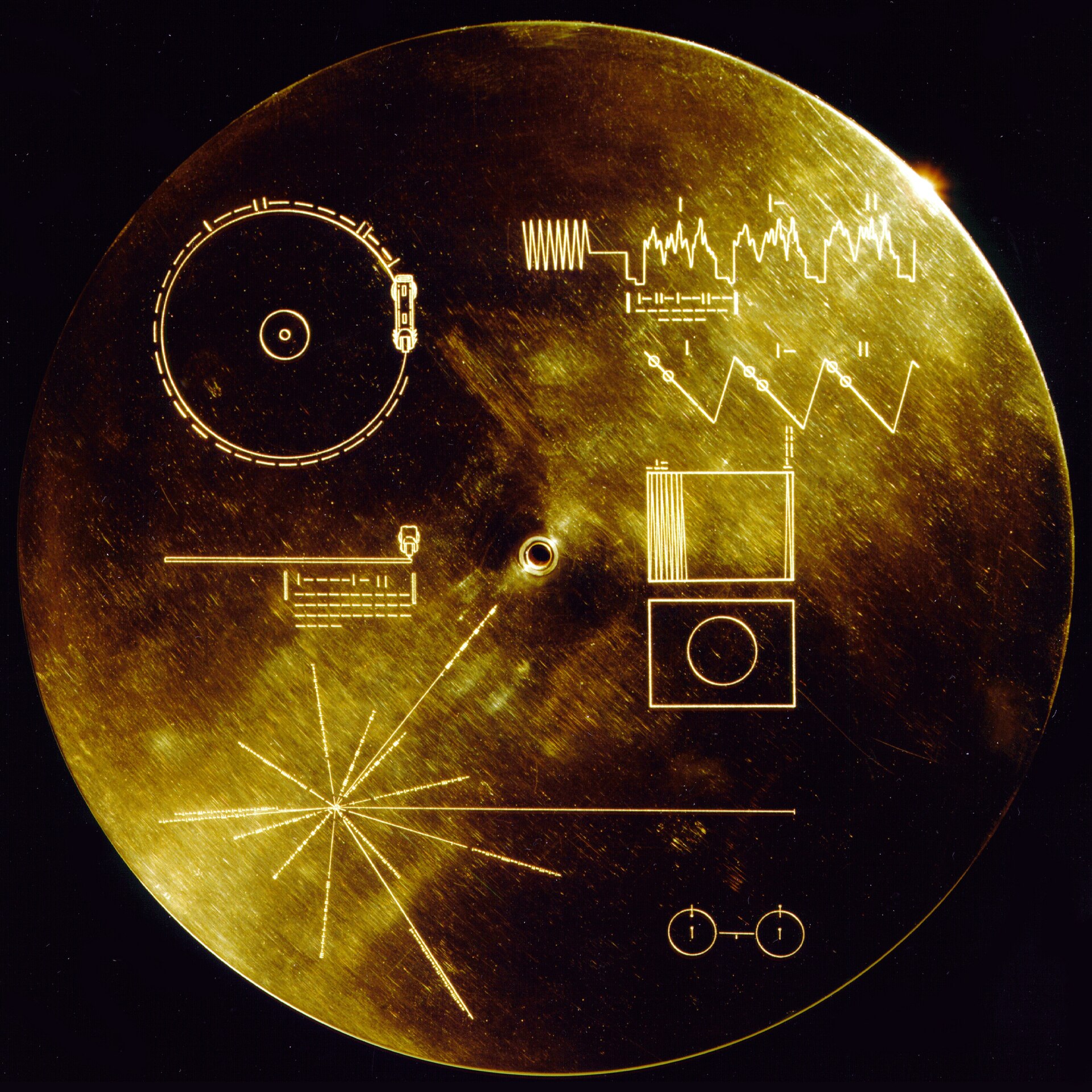
Bolted to the side of each Voyager spacecraft is a 12-inch, gold-plated copper phonograph record, sealed in an aluminum cover etched with instructions for playing it. Inside are 115 encoded images, greetings in 55 languages, a 90-minute selection of music from Bach to Chuck Berry, and the sounds of Earth — surf, thunder, a kiss, a mother’s first words to her child. Both records are now travelling through interstellar space, roughly 15 to 24 billion kilometres from home, and will outlast the planet that made them by hundreds of millions of years. This is Guide № 003 in The Love Space Guide series.
Get the Full Collectible Guide (Free PDF)
The Voyager Golden Record — in a beautifully designed, printable booklet. The Love Space Guide № 003.
Why NASA Bolted a Record to a Spacecraft
The Voyager Golden Record grew out of an idea NASA had already tried in smaller form: the Pioneer 10 and 11 plaques of the early 1970s, which carried a simple engraved diagram of two human figures and a map of our Sun’s location. For the Voyager mission, launched in 1977 to study the outer planets, a committee chaired by astronomer Carl Sagan was asked to create something richer — a portrait of Earth intended for any intelligence that might one day find the craft after their planetary work was done.
The team had roughly six weeks to assemble the contents, working under real deadlines set by the launch window. The record was pressed onto copper and plated in gold partly for durability and partly because gold resists corrosion over enormous spans of time. Sagan and his colleagues understood the odds of it ever being played were minute; they often described it as a message aimed as much at humanity as at any extraterrestrial listener.
What Is Actually on the Record
The audio side opens with spoken greetings in 55 languages, from ancient Akkadian to modern Mandarin, followed by a section titled “The Sounds of Earth” — volcanoes, rain, birds, a heartbeat, footsteps, and Morse code. Then comes the music: 27 tracks spanning Bach’s Brandenburg Concerto No. 2, Javanese gamelan, Navajo night chant, Peruvian panpipes, Blind Willie Johnson’s “Dark Was the Night, Cold Was the Ground,” and Chuck Berry’s “Johnny B. Goode.” The selections were chosen to represent a broad range of human cultures rather than a Western “greatest hits.”
The record also encodes 115 images as analog signals, including diagrams of human anatomy, DNA structure, the Solar System, and photographs of landscapes, food, and people. Two contributions are frequently singled out: a message of peace in Kurt Waldheim’s capacity as UN Secretary-General, and a written greeting from US President Jimmy Carter that reads in part, “This is a present from a small, distant world, a token of our sounds, our science, our images, our music, our thoughts and our feelings.”
How Aliens Would Be Expected to Play It
The aluminum protective cover is engraved with a set of diagrams meant to work regardless of language. A drawing shows the record and the ceramic stylus in the correct playing position, with instructions on rotation speed given in binary, timed against a fundamental unit derived from the transition frequency of a hydrogen atom — the most common element in the universe, and therefore a reference point any advanced civilization should recognize.
The cover also carries a “pulsar map,” the same style of diagram used on the Pioneer plaques. It plots the position of our Sun relative to 14 pulsars, each identified by its precise spinning frequency written in binary. Because pulsars slow at known rates, a finder could in principle read the map both as a set of directions to Earth and as a rough timestamp of when the record was made.
Where the Records Are Now
Voyager 1 crossed into interstellar space — the region beyond the Sun’s heliosphere — in 2012, and Voyager 2 followed in 2018, making them the only human-made objects to have done so. Both continue to send back data through NASA’s Deep Space Network, though their power sources, radioisotope thermoelectric generators, are fading and instruments are being switched off one by one to extend the mission into the 2030s.
Neither craft is aimed at a particular star, but their trajectories carry them past distant ones over immense timescales. It is commonly cited that in roughly 40,000 years Voyager 1 will pass within about 1.6 light-years of a star called Gliese 445 in the constellation Camelopardalis. At their current speeds — around 17 kilometres per second — the Voyagers cover the distance from the Earth to the Moon in a matter of hours, yet still need tens of thousands of years to approach even a neighbouring star.
The People Behind the Message
The project was a small human story as much as a scientific one. Carl Sagan led the committee, and the creative director was Ann Druyan, who would later marry Sagan. During production, Druyan’s brain waves, heartbeat, and eye movements were recorded and encoded onto the disc; she has said she was thinking, among other things, about having just fallen in love with Sagan. Astronomer Frank Drake designed the technical encoding, and artist Jon Lomberg oversaw much of the image selection.
Their choices involved genuine compromise and even a few gaps — copyright issues, for instance, kept some music off the disc, and the image set was carefully vetted to avoid content that might be misread. What emerged was less a complete encyclopedia of Earth than a deliberately hopeful, curated snapshot, made by a handful of people who knew almost no one would ever open it.
Myths Worth Retiring
Myth: The Golden Record is a music album meant for humans on Earth. It was pressed as a genuine phonograph record, but only a small number of copies exist on Earth; the two originals are physically attached to spacecraft leaving the Solar System, and the disc was designed as a message to a potential finder, not a commercial release.
Myth: NASA aimed the Voyagers at a specific alien planet. The spacecraft were designed to study Jupiter, Saturn, and their moons; their escape from the Solar System is a consequence of gravity-assist flybys, and their paths are not directed at any known inhabited world.
Myth: The record will last forever. It is extremely durable — gold-plated and shielded — and is often estimated to remain readable for hundreds of millions of years or more, but “essentially permanent on human timescales” is not the same as truly eternal.
Frequently Asked Questions
Has anything ever played the Golden Record?
As far as anyone knows, no. The two flight copies have never been played since launch, and given the emptiness of interstellar space, the realistic expectation is that they never will be. The record functions mainly as a symbolic message and a cultural time capsule.
Can you listen to the record’s contents on Earth?
Yes. NASA has published the audio, images, and greetings online, and the full contents have since been reissued in various formats, so anyone can hear the same music and sounds that are travelling through space aboard the Voyagers.
Why gold, and why a record instead of digital storage?
Gold resists corrosion over vast timescales, which suited a message meant to survive for millions of years. An analog record was chosen because the technology of the mid-1970s made it a robust, self-contained medium that could be decoded from physical principles alone, without needing any of Earth’s computers or file formats.
More The Love Space Guides
The Love Space Guide is a numbered series — one tightly focused subject at a time, each with its own downloadable collectible edition. Guide № 001 is The Apollo 11 Moon Landing, Guide № 002 is How the International Space Station Actually Works, This is Guide № 003. More editions are on the way.
🚀 Join Love Space
Every week, get hidden stories, local secrets, and travel inspiration from people who live and love it.