
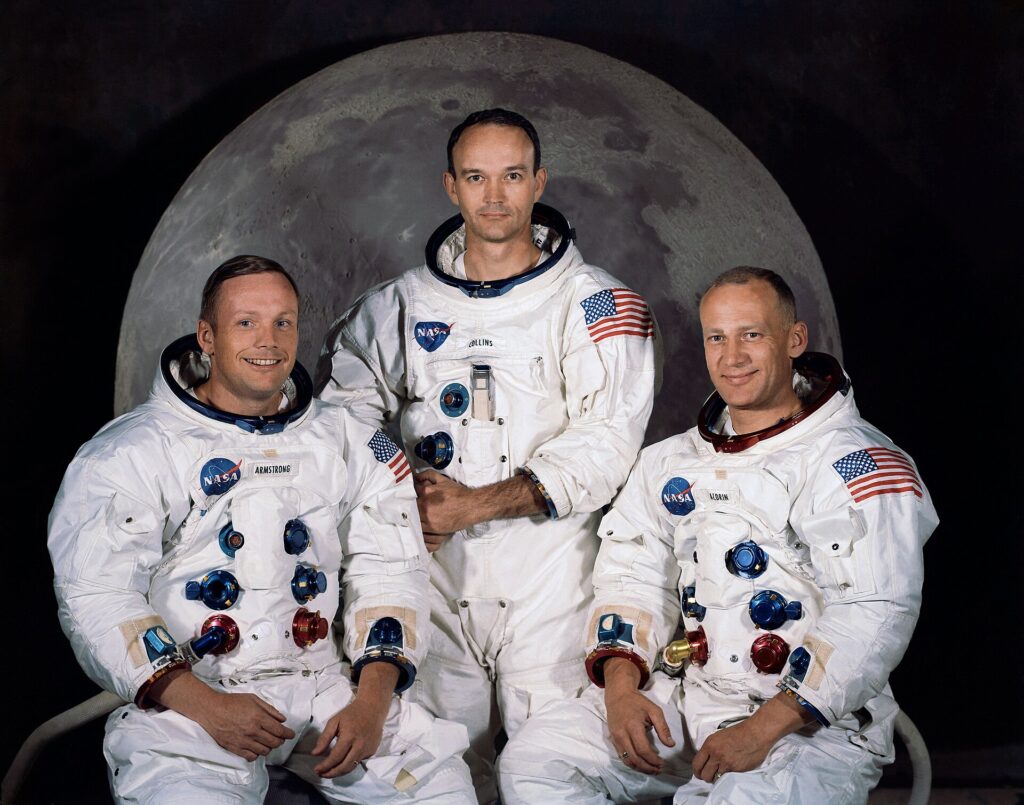
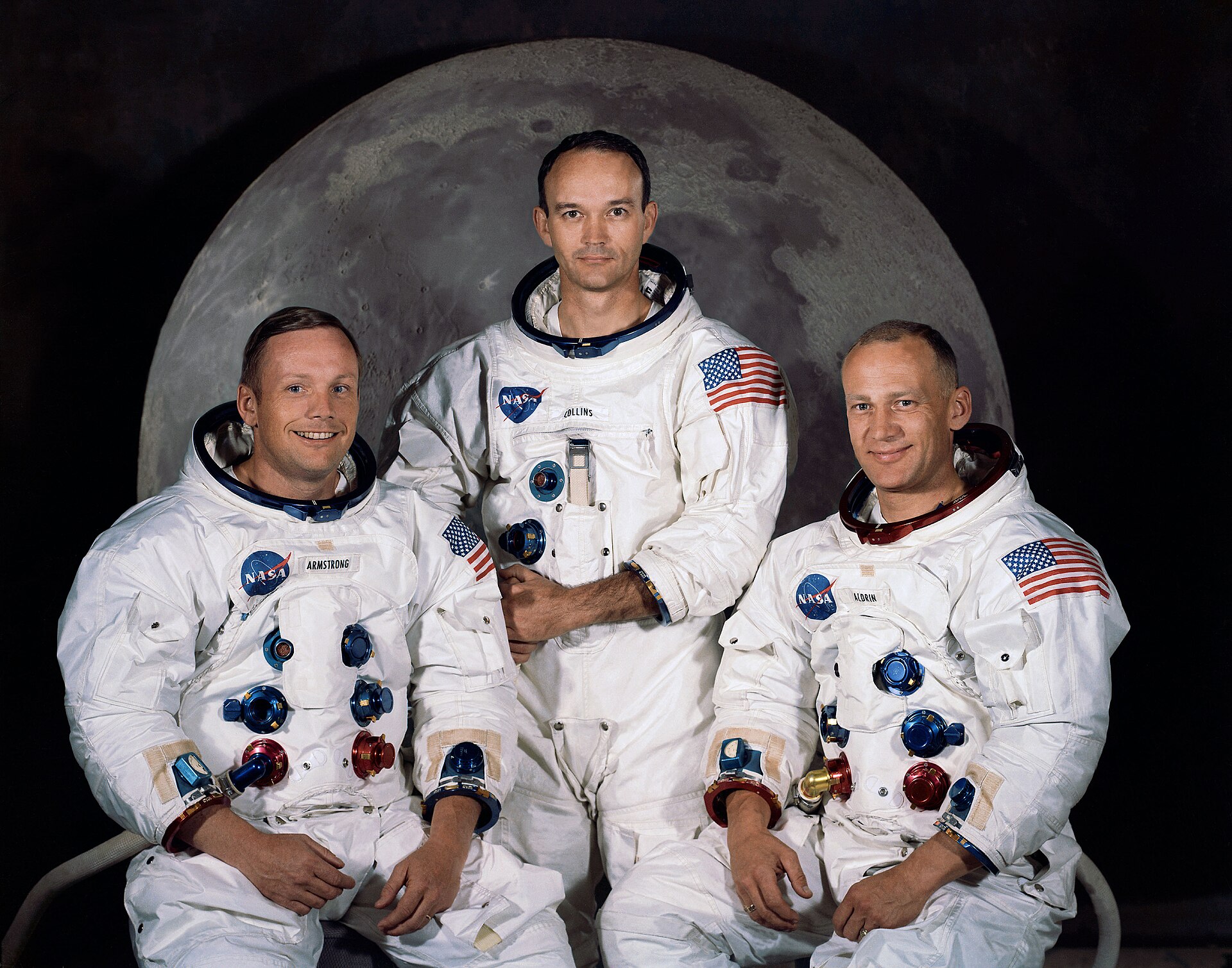
On July 20, 1969, Neil Armstrong stepped off the ladder of the lunar module Eagle and onto the Sea of Tranquility, with an estimated 600 million people listening on live radio and television. The whole descent nearly ended in an abort: the guidance computer flashed unfamiliar “1202” and “1201” alarms, and Armstrong flew the craft manually to avoid a boulder-strewn crater, touching down with only seconds of usable fuel left in the tanks. This is Guide № 001 in The Love Space Guide series. After a roughly three-day coast to the Moon, the mission split into two vehicles — the command module Columbia, which stayed in lunar orbit with Collins, and the lunar module Eagle, which carried Armstrong and Aldrin down to the surface.
The goal was set publicly by President John F. Kennedy in 1961, who challenged the United States to land a man on the Moon and return him safely to Earth before the decade was out. Apollo 11 met that goal with about five months to spare, splashing down in the Pacific Ocean on July 24, 1969.
Get the Full Collectible Guide (Free PDF)
The Apollo 11 Moon Landing — in a beautifully designed, printable booklet. The Love Space Guide № 001.
Those First Steps and Famous Words
Armstrong’s first words on the surface were, “That’s one small step for man, one giant leap for mankind.” He later said he intended to say “one small step for a man,” and the missing article has been debated ever since. Aldrin joined him about twenty minutes later, describing the stark lunar landscape as “magnificent desolation.”
The two astronauts spent roughly two and a quarter hours outside the lunar module. They collected about 21.5 kilograms (around 47 pounds) of rock and soil samples, planted a United States flag, and set up experiments including a seismometer and a laser reflector that scientists still bounce lasers off today to measure the Earth–Moon distance.
How the Landing Actually Worked
The lunar module was a two-stage spacecraft. The descent stage carried the landing engine, fuel, and landing legs and served as a launch pad; the ascent stage was the crew cabin that later fired its own engine to return Armstrong and Aldrin to lunar orbit to rejoin Collins. Because there is no atmosphere on the Moon, there were no parachutes or wings involved — the descent relied entirely on rocket thrust to slow the craft from orbital speed to a soft touchdown.
Guidance came from the Apollo Guidance Computer, a machine with far less processing power and memory than a modern pocket calculator or phone. During the descent it became overloaded and issued program alarms, but mission controllers in Houston recognized the alarms as non-fatal and gave the call to continue. Armstrong took semi-manual control to steer past a rocky area, which is why the landing used more fuel than planned.
The Man Who Stayed Behind
Michael Collins is sometimes overlooked, but his role was essential: he piloted the command module Columbia alone in lunar orbit while his crewmates walked below. On each orbit he passed around the far side of the Moon, losing all radio contact with Earth for roughly 48 minutes at a time. Rather than describing himself as lonely, Collins later wrote that he did not feel that way and was aware of his responsibility to bring everyone home.
What Came After
Apollo 11 was the first crewed lunar landing, but not the last. Five more Apollo missions landed successfully — Apollo 12, 14, 15, 16, and 17 — bringing the total number of people who have walked on the Moon to twelve. Apollo 13, famously, suffered an in-flight explosion and had to abort its landing, with the crew returning safely to Earth.
The last crewed Moon landing was Apollo 17 in December 1972. No human has returned to the lunar surface since, though space agencies including NASA are working toward crewed missions again through the Artemis program.
Myths Worth Retiring
Myth: You can see the Apollo landing sites, flags, and footprints from Earth with a backyard telescope. No telescope on Earth has the resolving power to see objects that small at that distance. The hardware left on the Moon has, however, been photographed from lunar orbit by NASA’s Lunar Reconnaissance Orbiter, which has imaged the descent stages and even the astronauts’ tracks.
Myth: The waving American flag proves the footage was filmed on Earth, since there is no wind on the Moon. The flag appears to “wave” because it was held out by a horizontal rod along its top edge, and the ripples came from the astronauts twisting the pole into the ground. In the vacuum of the Moon there is no air resistance to damp the motion, so the fabric kept moving longer than it would on Earth.
Myth: Neil Armstrong was chosen because he was the best pilot, or for purely symbolic reasons. The main practical reason Armstrong exited first was the layout of the lunar module: the hatch opened inward and to one side, and given the cramped cabin and the astronauts’ bulky suits, it was simply easier for the commander, positioned on that side, to leave first.
Frequently Asked Questions
How long did the astronauts stay on the Moon?
The lunar module Eagle was on the surface for about 21.5 hours in total. Of that, Armstrong and Aldrin spent roughly two and a quarter hours outside on the surface; the rest of the time was spent inside the cabin preparing, resting, and getting ready to lift off.
Is the equipment they left behind still on the Moon?
Yes. The descent stage of the lunar module, scientific instruments, the flag, and other items remain at the Sea of Tranquility. The laser retroreflector left by the crew is still used by observatories today to measure the distance between the Earth and the Moon with great precision.
Did the Moon landing really happen, or was it staged?
It really happened. The evidence is overwhelming: hundreds of kilograms of lunar samples studied by scientists worldwide, independent tracking of the missions by other countries, and modern orbital photographs of the landing sites. The idea that it was faked is a conspiracy theory not supported by the physical record.
More The Love Space Guides
The Love Space Guide is a numbered series — one tightly focused subject at a time, each with its own downloadable collectible edition. This is Guide № 001. More editions are on the way.
🚀 Join Love Space
Every week, get hidden stories, local secrets, and travel inspiration from people who live and love it.