
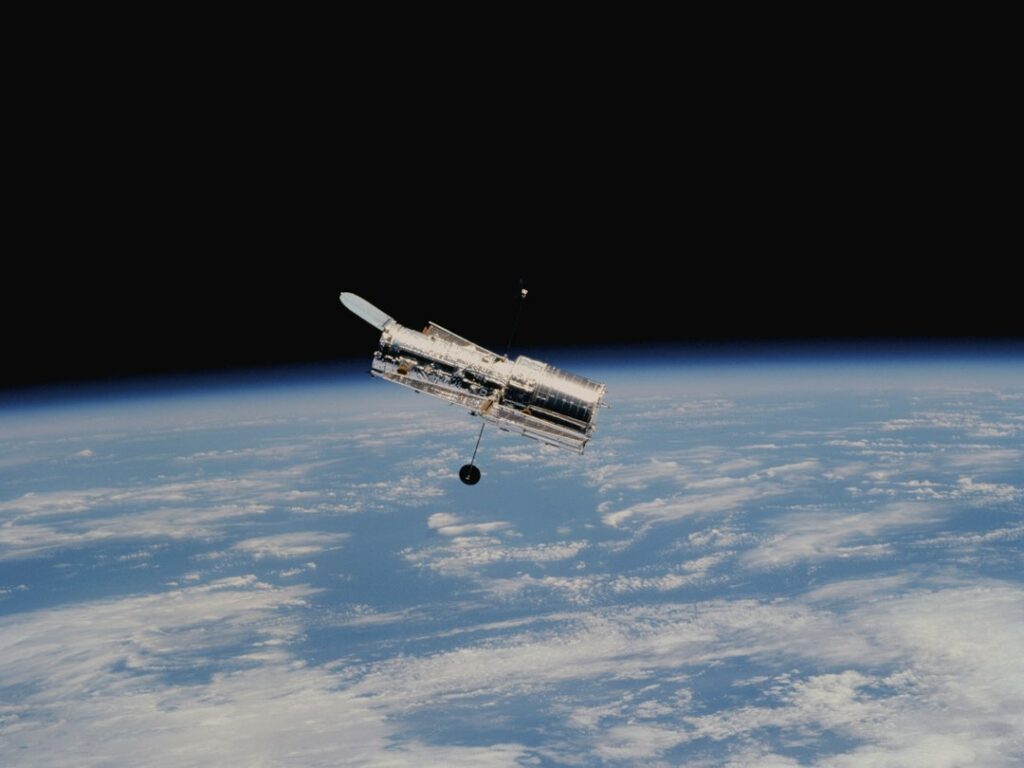
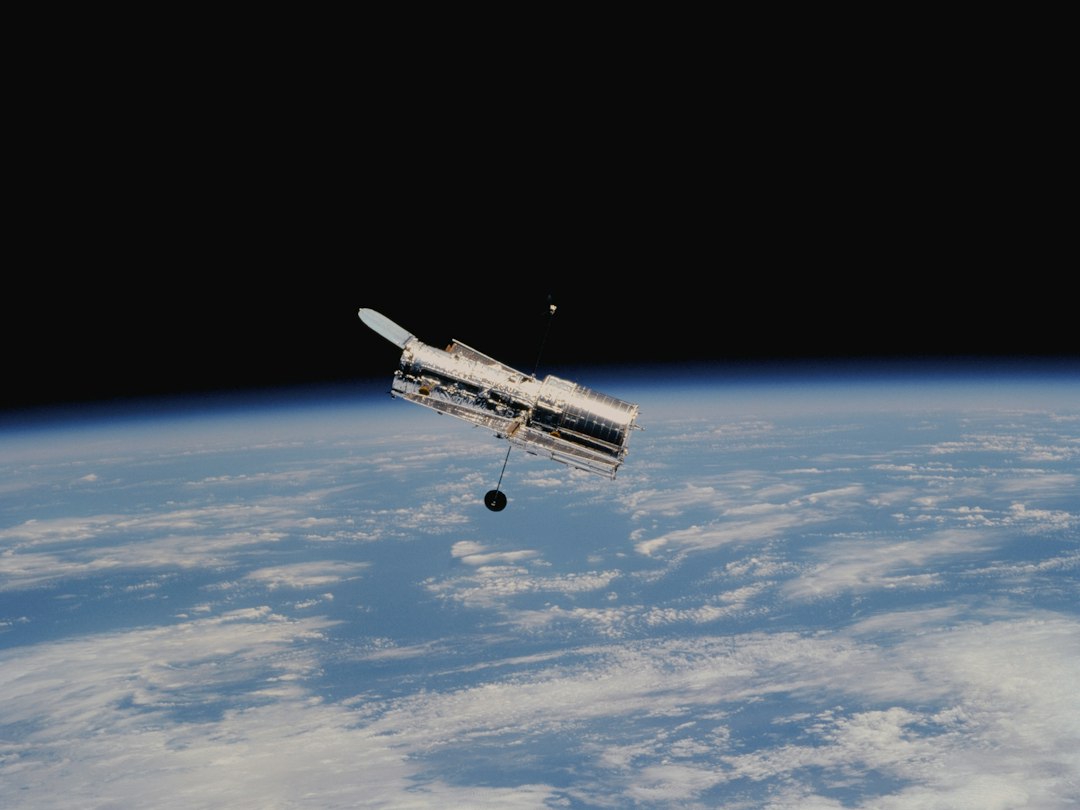
When the Hubble Space Telescope sent back its first images in 1990, they were blurry — the result of a primary mirror ground too flat at its edge by about one fiftieth the width of a human hair. That tiny error nearly sank the whole mission, until astronauts fitted the telescope with what amounted to a pair of corrective spectacles in 1993. This is Guide № 007 in The Love Space Guide series.
Get the Full Collectible Guide (Free PDF)
The Hubble Space Telescope — in a beautifully designed, printable booklet. The Love Space Guide № 007.
A Telescope Named for the Man Who Measured the Universe
Hubble is named after astronomer Edwin Hubble, who in the 1920s showed that the fuzzy “spiral nebulae” of the night sky were in fact entire galaxies far beyond our own, and that they are rushing apart — the observation at the root of the expanding-universe model. The telescope carrying his name launched on 24 April 1990 aboard the Space Shuttle Discovery on mission STS-31. It was a joint project of NASA and the European Space Agency, and it remains one of the longest-running and most productive scientific instruments ever flown.
Why Put a Telescope in Space at All
Earth’s atmosphere is both a blessing and a nuisance for astronomers. It keeps us alive, but it also blurs incoming starlight (the reason stars appear to twinkle) and absorbs much of the ultraviolet and infrared light that carries vital information about distant objects. By orbiting roughly 535 kilometres above the surface — circling the planet about every 95 minutes — Hubble sits above that turbulence and can resolve detail far finer than most ground-based telescopes of its era. Its primary mirror is 2.4 metres across, modest by observatory standards, but its clear, steady view is what made the difference.
The Flawed Mirror and the Rescue
Within weeks of launch, engineers realised the images were not as sharp as promised. The cause was spherical aberration: the edge of the mirror had been polished to the wrong curve because a test instrument was assembled incorrectly. The fix came in December 1993, when the crew of servicing mission STS-61 installed a device called COSTAR and a new camera built with corrective optics, effectively giving Hubble its glasses. Over five servicing missions between 1993 and 2009, shuttle astronauts repeatedly upgraded instruments, replaced gyroscopes and solar arrays, and extended the observatory’s life by decades.
How Hubble Actually Takes a Picture
Hubble does not snap ready-made colour photographs. Its cameras record in black and white through a wheel of filters, each admitting a narrow slice of light. Scientists then combine separate exposures — often assigning a colour to each filter — to build the final image. This is why Hubble pictures are best described as true representations of real data rather than literal snapshots. The telescope is operated day to day by the Space Telescope Science Institute in Baltimore, while the spacecraft itself is managed by NASA’s Goddard Space Flight Center.
The Deep Fields and What We Learned
Some of Hubble’s most important work came from pointing at apparently empty patches of sky for days at a time. The Hubble Deep Field (1995) and later the Ultra Deep Field (2004) revealed thousands of galaxies in regions that looked black to the naked eye, letting astronomers look back toward the early universe. Hubble data also helped pin down the universe’s expansion rate and contributed to the discovery that that expansion is accelerating. You can browse the full public archive of images and findings at HubbleSite and the European mirror at ESA/Hubble.
Seeing Hubble’s Legacy in Person
Hubble is still operating in orbit and cannot be visited, but the hardware and history behind it are on public display. Space Shuttle Discovery, which carried Hubble aloft, is preserved at the Smithsonian National Air and Space Museum‘s Udvar-Hazy Center in Virginia. Hubble’s eventual successor for infrared astronomy, the James Webb Space Telescope, launched in 2021 and works alongside it rather than replacing it — the two study the cosmos at different wavelengths.
Myths Worth Retiring
Myth: Hubble was the first space telescope. It was not. Several orbiting observatories flew before it; Hubble’s fame comes from its longevity, its resolution, and the public reach of its images, not from being first.
Myth: Hubble takes real-colour photographs just as your eye would see them. Its images are composites built from separate black-and-white exposures through coloured filters, assembled afterwards. They are scientifically accurate but are not single click-of-a-shutter colour photos.
Myth: James Webb replaced Hubble. Webb observes mainly in the infrared and complements Hubble, which still covers ultraviolet and visible light. Both are working at the same time.
Frequently Asked Questions
Is the Hubble Space Telescope still working?
Yes. Despite occasional glitches with its ageing gyroscopes and electronics, Hubble continues to make observations more than three decades after launch and regularly releases new science. NASA posts current mission status on its official Hubble pages.
Can I see Hubble from the ground?
Sometimes. Because it orbits a few hundred kilometres up, Hubble can occasionally be spotted as a moving point of light crossing the sky near dawn or dusk, from locations close enough to its orbital path. Satellite-tracking tools can tell you if and when it will pass over your area.
How did astronauts reach Hubble to repair it?
Hubble was designed to be serviced by the Space Shuttle. Crews flew up, captured the telescope with the shuttle’s robotic arm, and carried out repairs on spacewalks. The final servicing mission was in 2009; since the shuttle’s retirement, no further crewed servicing has taken place.
More The Love Space Guides
The Love Space Guide is a numbered series — one tightly focused subject at a time, each with its own downloadable collectible edition. Guide № 001 is The Apollo 11 Moon Landing, Guide № 002 is How the International Space Station Actually Works, Guide № 003 is The Voyager Golden Record, Guide № 004 is Why Rockets Launch From the Equator, Guide № 005 is The Mars Rovers, Guide № 006 is What Astronauts Actually Eat, This is Guide № 007. More editions are on the way.
🚀 Join Love Space
Every week, get hidden stories, local secrets, and travel inspiration from people who live and love it.