
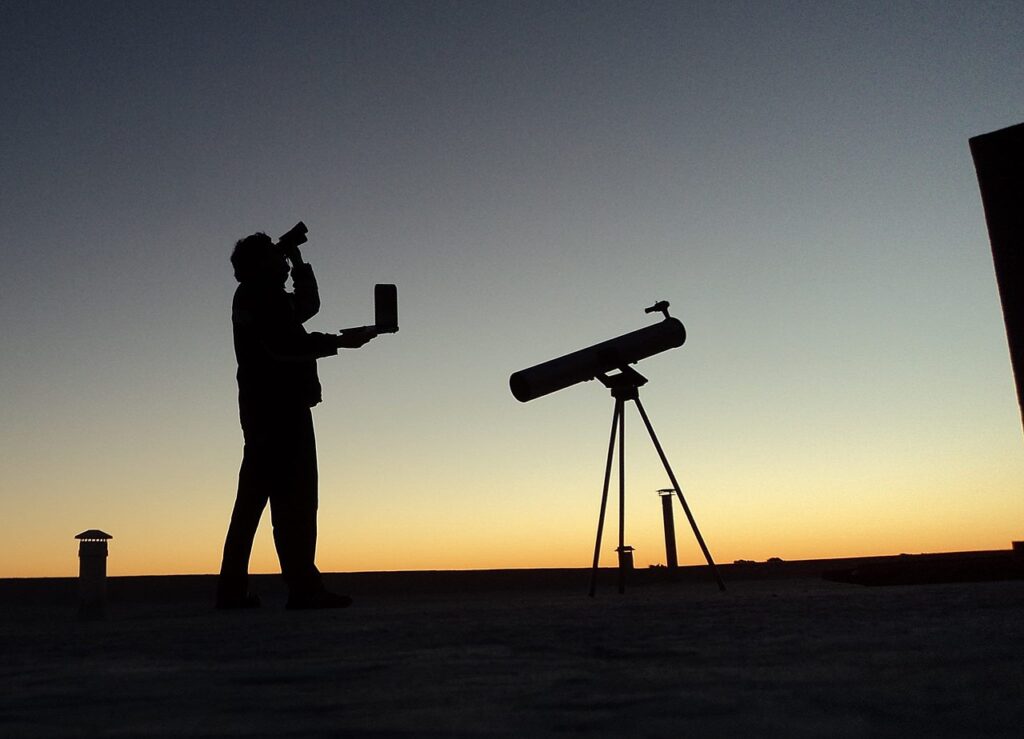
The night sky is the oldest show on Earth, and you don’t need a telescope, a dark sky site, or any special training to start enjoying it. Whether you’re curious about the planets, want to spot satellites like the International Space Station, or simply find peace looking up at the stars, stargazing is one of the most accessible ways to connect with space.
This guide will walk you through everything you need to begin your journey as a stargazer, from what to look for on your first night to how to gradually deepen your knowledge of the cosmos above.
Start With Your Naked Eyes
The best tool for beginning stargazers is the one you already have: your eyes. Before investing in any equipment, spend a few nights simply looking up. Your eyes need about 20 to 30 minutes to fully adapt to darkness, a process called dark adaptation. During this time, specialized cells in your retina become more sensitive to faint light, revealing stars you couldn’t see at first glance.
Find a spot away from direct streetlights—even your backyard or a local park works. Face away from the brightest lights, and give yourself time. You’ll be surprised how many more stars appear as your eyes adjust.
Start by learning a few easy-to-recognize patterns. The Big Dipper is visible year-round in the Northern Hemisphere and acts as a pointer to other constellations. The two stars at the end of its “bowl” point toward Polaris, the North Star. Orion, with its distinctive belt of three stars, dominates winter skies. In summer, look for the bright Summer Triangle formed by Vega, Deneb, and Altair.
Use a Stargazing App
Smartphone apps have revolutionized stargazing for beginners. Apps like SkySafari, Stellarium, and Star Walk use your phone’s GPS and compass to show you exactly what’s above you in real time. Point your phone at any part of the sky, and the app labels stars, constellations, planets, and satellites.
These apps also let you search for specific objects. Want to see Jupiter? The app will show you exactly where to look. Curious when the ISS will pass overhead? Many apps include satellite tracking and will alert you to upcoming visible passes.
The red night mode feature in most astronomy apps is essential—it preserves your dark adaptation by dimming your screen and filtering out blue light that disrupts your night vision.
Learn What’s Visible Each Season
The night sky changes throughout the year as Earth orbits the Sun. Different constellations dominate different seasons, and the planets move against the background stars.
In summer 2026, look for Saturn rising in the evening sky—its rings are visible even through a small telescope. Jupiter will be prominent in the pre-dawn hours. Mars, Venus, and Mercury take turns appearing as “morning stars” or “evening stars” depending on their position relative to Earth and the Sun.
The Moon itself is endlessly fascinating. Even without magnification, you can see dark patches called maria (Latin for “seas”), which are ancient volcanic plains. As the Moon goes through its phases each month, different features become visible along the terminator—the line between light and shadow where surface details stand out in sharp relief.
When to Consider Binoculars or a Telescope
Once you’re comfortable finding your way around the sky, binoculars are an excellent next step—and often better than a telescope for beginners. A pair of 7×50 or 10×50 binoculars (the first number is magnification, the second is the diameter of the front lens in millimeters) will reveal Jupiter’s four largest moons, Saturn’s oblong shape, countless star clusters, and the craters of the Moon in stunning detail.
Binoculars are portable, affordable, easy to use, and show a wide field of view that makes locating objects simple. They don’t require any setup or alignment, unlike most telescopes.
If you do decide to buy a telescope, avoid department store models with exaggerated magnification claims. A quality 6-inch or 8-inch Dobsonian reflector telescope offers the best value for beginners—simple, stable, and powerful enough to show the cloud bands of Jupiter, the rings of Saturn, the Orion Nebula, and hundreds of other deep-sky objects.
Join the Community
Stargazing is more fun with others. Local astronomy clubs host regular star parties—gatherings where experienced astronomers set up telescopes and share views with anyone who shows up. These events are almost always free and welcoming to beginners. You’ll get to look through a variety of telescopes, ask questions, and learn from people who’ve been observing for decades.
Many planetariums and science centers also offer public observing nights and beginner workshops. Online communities on Reddit, astronomy forums, and social media can answer questions and help you plan your observing sessions.
Your First Night Under the Stars
For your first dedicated stargazing session, check the weather forecast and choose a clear night close to a new moon, when the sky is darkest. Dress warmer than you think you’ll need—even summer nights get chilly when you’re sitting still. Bring a red flashlight or use your phone’s red mode to read star charts without ruining your night vision.
Set a modest goal: find one constellation, watch the ISS pass overhead, or simply observe the Moon. The universe isn’t going anywhere, and there’s no pressure to see everything at once.
The more you look up, the more you’ll see—not just with your eyes, but with your understanding. Every bright point in the night sky has a story written in light that has traveled for years, decades, or millennia to reach you.
Want to deepen your connection to the cosmos? Subscribe to the Love Space newsletter and get one cosmic idea delivered to your inbox every day.