
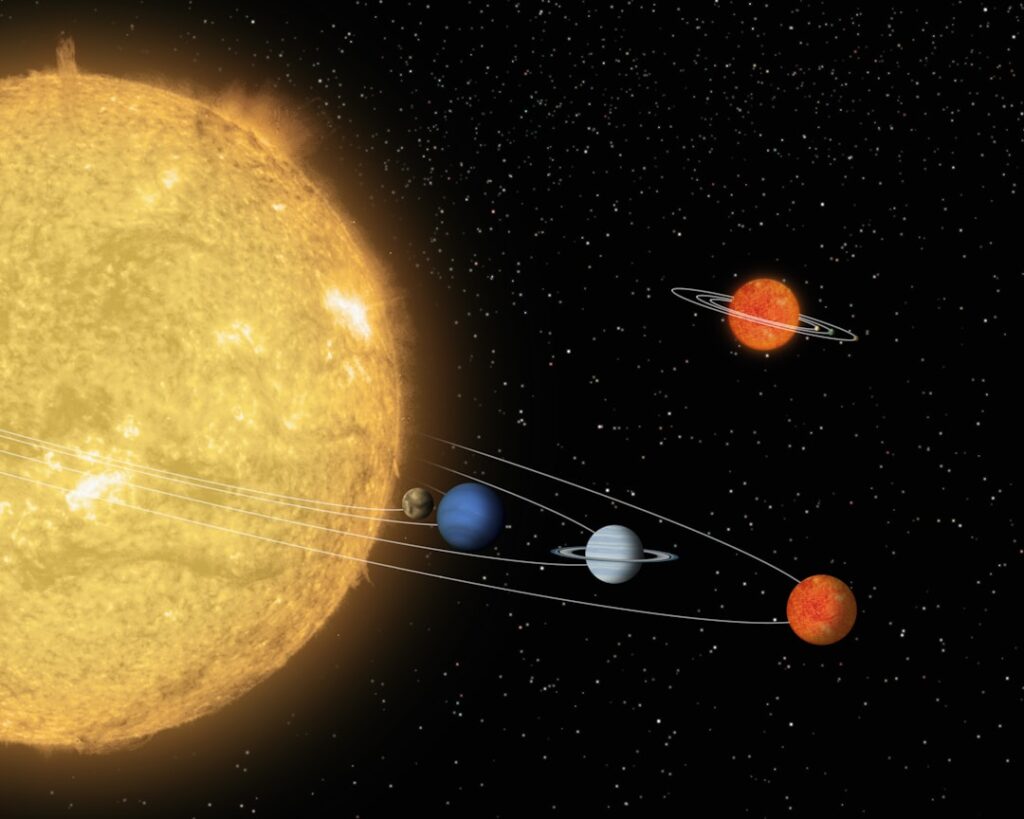
Our solar system is home to eight distinct worlds, each with its own personality, geology, and mysteries. Whether you’re new to astronomy or brushing up on the basics, this tour will take you from the Sun’s doorstep to the icy edge of the planetary neighborhood.
The Inner Rocky Planets
Mercury is the smallest planet and the closest to the Sun, orbiting at an average distance of just 36 million miles. Its surface is heavily cratered, resembling our Moon, and temperatures swing wildly from 800°F during the day to -290°F at night. NASA’s MESSENGER mission mapped Mercury in detail between 2011 and 2015, revealing ice hiding in permanently shadowed craters near the poles.
Venus is Earth’s near-twin in size, but that’s where the similarity ends. Its thick atmosphere of carbon dioxide traps heat in a runaway greenhouse effect, making the surface hot enough to melt lead—around 900°F. Sulfuric acid clouds shroud the planet, and the atmospheric pressure at the surface is 90 times that of Earth. Venus rotates so slowly that a day there lasts longer than its year.
Earth is the only planet known to harbor life. Its atmosphere, liquid water, protective magnetic field, and just-right distance from the Sun create conditions that make our world uniquely habitable. From space, Earth appears as a blue marble swirled with white clouds, a perspective that has inspired generations since the Apollo missions.
Mars, the Red Planet, has captivated us for centuries. It’s about half the size of Earth, with a thin carbon dioxide atmosphere and surface temperatures averaging around -80°F. NASA’s Perseverance rover and Ingenuity helicopter are currently exploring Jezero Crater, searching for signs of ancient microbial life. Mars has the largest volcano in the solar system, Olympus Mons, standing 16 miles high.
The Gas Giants
Jupiter is the king of planets—so massive that more than 1,300 Earths could fit inside it. This gas giant is composed mostly of hydrogen and helium, with no solid surface to land on. The Great Red Spot, a storm larger than Earth that has raged for centuries, is one of Jupiter’s most famous features. Jupiter has at least 95 known moons, including the four large Galilean moons: Io, Europa, Ganymede, and Callisto. Europa, with its subsurface ocean beneath an icy crust, is a prime target in the search for life beyond Earth. NASA’s Europa Clipper mission, launched in 2024, is currently en route to investigate.
Saturn is instantly recognizable by its spectacular ring system, made of billions of chunks of ice and rock ranging from dust-sized to house-sized. Saturn itself is a gas giant similar in composition to Jupiter, though less massive. Its moon Titan is the only moon in the solar system with a thick atmosphere and liquid lakes and rivers—though they’re made of methane and ethane, not water. The Cassini mission, which orbited Saturn from 2004 to 2017, revolutionized our understanding of this ringed world and its moons.
The Ice Giants
Uranus is an oddball. This ice giant rotates on its side, with its axis tilted 98 degrees—likely the result of a massive collision early in the solar system’s history. Uranus is composed of water, methane, and ammonia ices surrounding a small rocky core. The methane in its atmosphere gives it a pale blue-green color. It has faint rings and 27 known moons. Voyager 2 remains the only spacecraft to visit Uranus, flying by in 1986.
Neptune is the most distant planet from the Sun, orbiting at an average distance of 2.8 billion miles. Like Uranus, it’s an ice giant with a vivid blue color from atmospheric methane. Neptune has the strongest winds in the solar system, with speeds exceeding 1,200 miles per hour. Its largest moon, Triton, orbits backward compared to Neptune’s rotation—evidence that it was likely captured from the Kuiper Belt. Voyager 2 also remains the only visitor to Neptune, arriving in 1989.
Why These Eight Matter
Each planet tells part of the story of how our solar system formed 4.6 billion years ago from a spinning disk of gas and dust. The rocky inner planets formed close to the Sun where it was hot enough for metals and silicates to condense. The gas and ice giants formed farther out where volatile compounds like water, methane, and ammonia could freeze.
Studying these worlds helps us understand not just our own cosmic backyard, but the thousands of exoplanets now being discovered around other stars. The James Webb Space Telescope and future missions will continue to reveal new details about our planetary neighbors, reminding us that even in our own solar system, there’s still so much to explore.
Want more cosmic insights delivered to your inbox? Subscribe to the Love Space newsletter and get one fascinating space idea every day.