
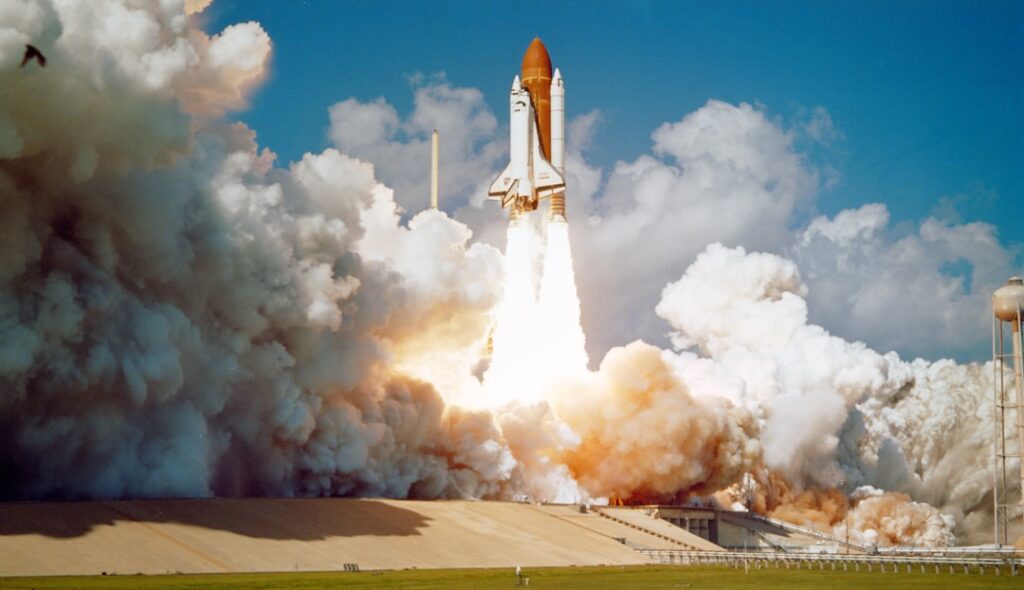
Every rocket launch is a triumph of physics. Whether it’s a SpaceX Falcon 9 lifting off from Kennedy Space Center or NASA’s Space Launch System carrying astronauts toward the Moon, the basic science hasn’t changed since the first liquid-fueled rockets of the 1920s. Rockets remain the only practical way to reach space, and understanding how they work reveals why spaceflight is so difficult—and so spectacular.
Newton’s Third Law: The Foundation of Rocketry
Rockets operate on a principle so simple it fits in a sentence: for every action, there is an equal and opposite reaction. This is Newton’s third law of motion, and it’s the reason rockets don’t need air to push against. When a rocket expels hot gas out of its engines at tremendous speed, the rocket itself is pushed in the opposite direction with equal force.
This is fundamentally different from how airplanes work. A jet engine pulls in air from the front, compresses it, mixes it with fuel, and expels it out the back. But above about 50,000 feet, there simply isn’t enough air for this process. Rockets carry everything they need: fuel and oxidizer. The Space Shuttle’s main engines, for example, burned liquid hydrogen and liquid oxygen—both stored in the massive orange external tank.
The math is straightforward but unforgiving. To accelerate a rocket, you need to throw mass out the back as fast as possible. The relationship is captured in the Tsiolkovsky rocket equation, which shows that the final velocity of a rocket depends on the exhaust velocity of the gases and the ratio of the rocket’s initial mass (full of propellant) to its final mass (nearly empty).
The Anatomy of a Rocket Engine
Most modern orbital rockets use liquid propellant engines. Inside the combustion chamber, fuel and oxidizer meet and ignite, creating gases that reach temperatures of 3,000 degrees Celsius or more. These gases expand rapidly and are channeled through a carefully shaped nozzle that accelerates them to supersonic speeds—often two to three kilometers per second.
The nozzle design is critical. A convergent-divergent (de Laval) nozzle first squeezes the gas through a narrow throat, then expands it through a widening bell. This converts the thermal energy of the hot gases into kinetic energy, maximizing thrust. The iconic bell shape you see on the Merlin engines of a Falcon 9 or the RS-25 engines on SLS isn’t just for show—it’s precision engineering.
Solid rocket boosters, like those used on SLS and the retired Space Shuttle, work on the same principle but store propellant as a solid grain that burns from the inside out. Once ignited, they can’t be throttled or shut down, which is why most modern orbital rockets use liquid engines for their core stages—they offer control.
Why Rockets Need Stages
The rocket equation presents a brutal challenge: to go faster, you need more propellant, but more propellant means more mass, which requires even more propellant to accelerate. The solution is staging. By dropping empty fuel tanks and engines along the way, a rocket sheds dead weight and becomes more efficient.
The Saturn V that carried Apollo astronauts to the Moon used three stages. The first stage (S-IC) burned for just two and a half minutes, lifting the entire stack to 42 miles altitude before falling away into the Atlantic. The second stage (S-II) took over, burning for six minutes to reach near-orbital velocity. The third stage (S-IVB) completed the journey to orbit and later reignited to send the crew toward the Moon.
SpaceX’s Falcon 9 uses two stages but lands and reuses the first stage, a game-changing innovation that has dramatically reduced launch costs. The physics of staging hasn’t changed, but the economics have.
Overcoming Earth’s Gravity Well
Reaching space isn’t just about altitude—it’s about speed. The Kármán line, at 100 kilometers above sea level, is often called the edge of space, but crossing it doesn’t keep you there. To stay in orbit, a spacecraft must travel at approximately 28,000 kilometers per hour (17,500 mph) parallel to Earth’s surface. At this speed, the spacecraft is continuously falling toward Earth, but the curvature of the planet means it keeps missing.
Achieving orbital velocity requires enormous energy. A fully fueled Falcon 9 weighs about 549,000 kilograms at liftoff but delivers a payload of just 22,800 kilograms to low Earth orbit. That’s a mass ratio of 24 to 1. Roughly 85 to 90 percent of a rocket’s mass at launch is propellant.
Escaping Earth’s gravity entirely—to travel to the Moon or Mars—requires even more energy. The escape velocity from Earth’s surface is about 40,000 kilometers per hour. This is why interplanetary missions often use orbital mechanics and gravitational assists to reduce fuel requirements.
The Limits and Future of Rocket Science
Chemical rockets have taken us to the Moon and sent probes to the edge of the solar system, but they have limits. The exhaust velocity of chemical propellants tops out around 4.5 kilometers per second. For faster, more efficient deep-space travel, future missions may rely on ion drives, nuclear thermal propulsion, or even nuclear pulse propulsion—concepts that work on different principles but still obey Newton’s third law.
For now, though, the rockets lifting off from Earth rely on principles understood for a century. The engineering has become more sophisticated, the materials more advanced, and the reusability more practical, but the science remains rooted in action and reaction, combustion and acceleration.
Every launch is a reminder that spaceflight is hard-won, not because we lack imagination, but because physics demands it.
Want to explore more cosmic ideas? Subscribe to the Love Space newsletter and get one fascinating space fact delivered to your inbox every day.