
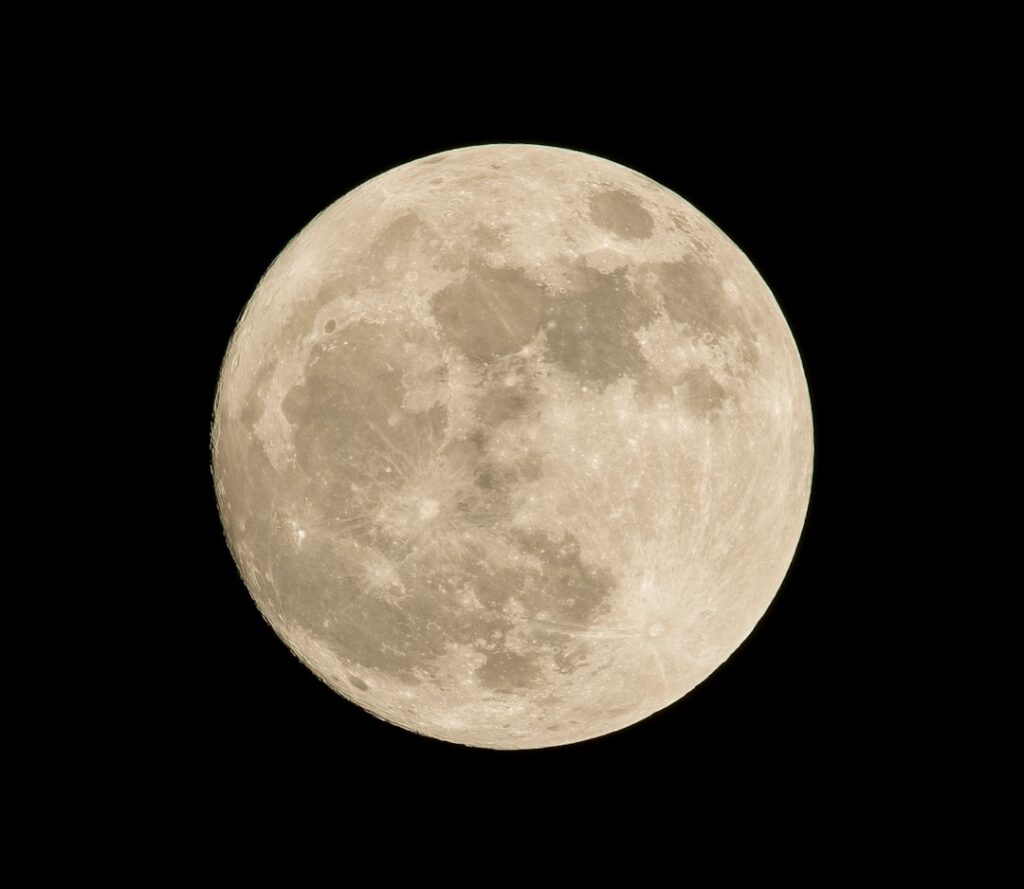
The Moon has hung in our sky for over four billion years, shaping tides, inspiring myths, and recently becoming humanity’s next frontier once again. Yet despite being our closest celestial neighbor—just 238,855 miles away on average—many people know surprisingly little about this remarkable world.
Whether you’re watching the Artemis missions unfold or simply curious about that bright disk in the night sky, here’s everything you should know about Earth’s companion.
How the Moon Was Born
The Moon didn’t form the way most moons in our solar system did. About 4.5 billion years ago, when Earth was still young and molten, a Mars-sized object called Theia slammed into our planet in a cataclysmic collision. The impact vaporized huge amounts of rock and sent debris spiraling into orbit around Earth.
Over time, this ring of molten material coalesced into the Moon. This giant impact hypothesis explains several puzzles: why the Moon has almost no iron core compared to Earth, why its composition closely matches Earth’s mantle, and why the Earth-Moon system has unusually high angular momentum.
Evidence from Apollo mission rock samples—which astronauts brought back between 1969 and 1972—supports this violent origin story. The lunar samples share oxygen isotope signatures with Earth, a chemical fingerprint that links the two bodies.
The Moon’s Physical Characteristics
The Moon is smaller than you might think. With a diameter of 2,159 miles, it’s about one-quarter the size of Earth—the largest moon relative to its planet in our solar system (excluding Pluto and Charon). If Earth were the size of a basketball, the Moon would be a tennis ball about 23 feet away.
That small size means weak gravity—just one-sixth of Earth’s. An astronaut who weighs 180 pounds on Earth weighs only 30 pounds on the Moon, which is why Apollo astronauts could bounce around so easily.
The Moon has no atmosphere to speak of, no weather, and no liquid water on its surface. Temperatures swing wildly: 260°F in direct sunlight, plunging to -280°F in darkness. Craters remain pristine for billions of years because there’s no wind or water to erode them.
But recent discoveries have revealed water ice hiding in permanently shadowed craters at the poles—a resource that future Artemis missions and lunar bases will depend on.
Why We Always See the Same Face
The Moon is tidally locked to Earth, meaning the same side always faces us. This happened because Earth’s gravity created tidal bulges in the Moon early in its history, gradually slowing its rotation until its orbital period matched its rotation period—both now about 27.3 days.
The far side of the Moon (not the “dark side”—it gets just as much sunlight) remained hidden from human eyes until 1959, when the Soviet Luna 3 spacecraft photographed it. The far side looks strikingly different: heavily cratered with almost none of the dark volcanic plains (maria) that make up the familiar “Man in the Moon” pattern.
Scientists believe the difference exists because Earth’s gravity affected how the Moon’s interior evolved, creating a thicker crust on the far side that prevented volcanic lava from reaching the surface as easily.
The Moon’s Influence on Earth
The Moon does more than light up the night sky. Its gravitational pull creates ocean tides—the water on the side facing the Moon bulges outward, and so does the water on the opposite side (because Earth itself is pulled more strongly than the far-side water).
These tidal forces are also gradually slowing Earth’s rotation. Days are getting longer by about 1.8 milliseconds per century. Simultaneously, the Moon is slowly drifting away from Earth at about 1.5 inches per year.
Billions of years ago, when the Moon was much closer, Earth’s days were only five hours long, and the Moon appeared enormous in the sky. Fossil records from ancient tidal deposits confirm this—geologists can count daily growth rings in 900-million-year-old shells and verify that years once had far more days.
Returning to the Moon
Twelve humans walked on the Moon between 1969 and 1972 during NASA’s Apollo program. After decades away, we’re going back. NASA’s Artemis program aims to land astronauts near the lunar south pole, where water ice and near-permanent sunlight make long-term bases feasible.
Artemis II will fly astronauts around the Moon in 2025, and Artemis III plans to land humans on the surface, including the first woman and first person of color to walk on the Moon. Unlike Apollo, Artemis is designed for sustained exploration—building habitats, testing technologies for Mars, and potentially mining resources.
Commercial companies like SpaceX, Blue Origin, and Intuitive Machines are building lunar landers, while international partners including ESA, JAXA, and CSA are contributing hardware and expertise. The Moon is becoming humanity’s proving ground for deep space exploration.
Earth’s companion has witnessed the entire history of life on our planet, from the first bacteria to the present day. Now, as we prepare to return, the Moon represents not just our past but our future—a stepping stone to becoming a truly spacefaring civilization.
Want to explore more cosmic wonders? Subscribe to the Love Space newsletter and get one fascinating space idea delivered to your inbox every day.