
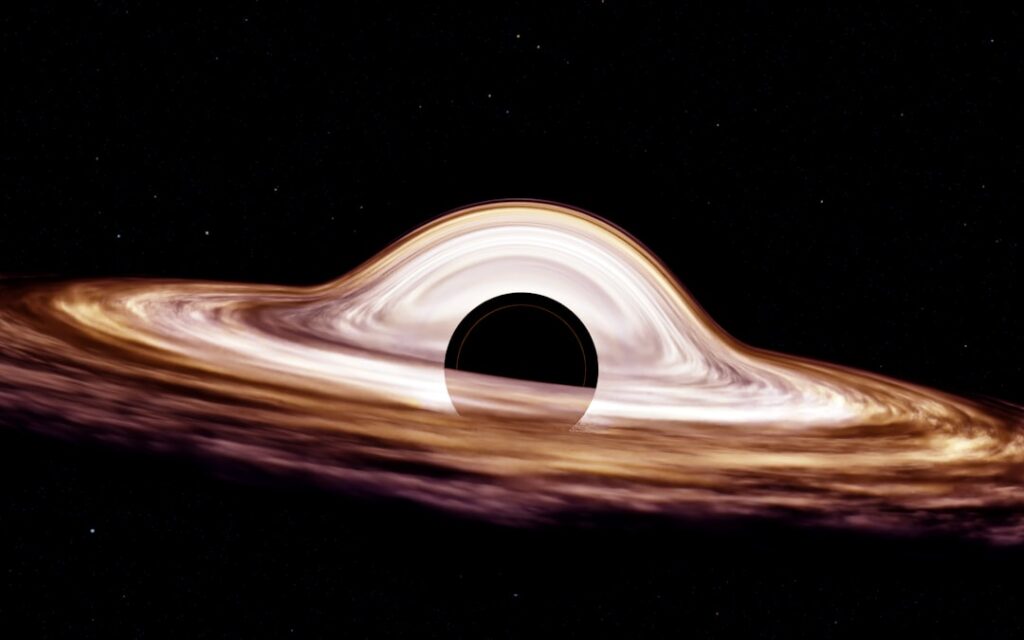
Black holes are among the most mysterious and extreme objects in the cosmos. They’re regions of spacetime where gravity is so strong that nothing—not even light—can escape once it crosses a boundary called the event horizon. Despite their reputation in science fiction, black holes are real, well-studied objects that play a crucial role in our understanding of the universe.
Let’s break down what black holes actually are, how they form, and why they matter to astronomers and physicists.
What Is a Black Hole?
A black hole forms when a massive amount of matter is compressed into an incredibly small space. The gravitational pull becomes so intense that it warps spacetime itself, creating a one-way region from which nothing can return.
The boundary of a black hole is called the event horizon. Cross that line, and you’re pulled inexorably toward the singularity at the center—a point where our current understanding of physics breaks down. The size of the event horizon depends on the black hole’s mass. For a black hole with the mass of our Sun, the event horizon would be about 3 kilometers across. For supermassive black holes like the one at the center of our Milky Way galaxy—Sagittarius A*, which weighs about 4 million times the mass of the Sun—the event horizon is roughly 24 million kilometers in diameter.
Despite their name, black holes aren’t empty voids. They contain an enormous amount of mass, just squeezed into an extraordinarily small volume.
How Do Black Holes Form?
There are several types of black holes, and they form in different ways:
- Stellar black holes form when massive stars—at least 20 times the mass of the Sun—exhaust their nuclear fuel and collapse under their own gravity. The outer layers explode in a supernova, while the core implodes to form a black hole. These typically range from a few to several dozen solar masses.
- Supermassive black holes sit at the centers of most galaxies, including our own. They contain millions to billions of solar masses. Scientists aren’t entirely sure how they formed, but they likely grew by consuming gas, dust, and stars over billions of years, and by merging with other black holes.
- Intermediate-mass black holes fall between stellar and supermassive varieties. They’re harder to detect and less well understood, but astronomers have found evidence for them in dense star clusters.
- Primordial black holes are hypothetical objects that might have formed in the extreme conditions shortly after the Big Bang. None have been confirmed, but they remain an area of active research.
How Do We Know Black Holes Exist?
Since black holes don’t emit light, we can’t see them directly. But astronomers have gathered overwhelming evidence for their existence by observing their effects on nearby matter and spacetime.
One method is watching how stars orbit an invisible object. Observations of stars near the center of the Milky Way show them whipping around at extraordinary speeds, pulled by the gravity of Sagittarius A*. These observations earned the Nobel Prize in Physics in 2020.
Black holes also reveal themselves through accretion disks—swirling rings of gas and dust that heat up to millions of degrees as they spiral inward, emitting intense X-rays we can detect with space telescopes.
In 2019, the Event Horizon Telescope collaboration released the first direct image of a black hole—actually, the glowing ring of material around the event horizon of the supermassive black hole at the center of galaxy M87, located 55 million light-years away. In 2022, they followed up with an image of Sagittarius A* in our own galaxy.
Gravitational wave detectors like LIGO and Virgo have also observed the ripples in spacetime created when two black holes merge, providing another powerful confirmation of their existence.
Why Black Holes Matter
Black holes aren’t just cosmic curiosities—they’re laboratories for testing the laws of physics under the most extreme conditions imaginable.
They sit at the intersection of Einstein’s general relativity, which describes gravity and the large-scale structure of the universe, and quantum mechanics, which governs the behavior of particles at the smallest scales. Understanding how these two theories work together at the event horizon and singularity is one of the great challenges of modern physics.
Black holes also play a key role in galaxy evolution. The supermassive black holes at galactic centers influence star formation throughout their host galaxies. When they consume matter, they release enormous amounts of energy that can heat surrounding gas, preventing it from collapsing into new stars. This feedback mechanism helps regulate how galaxies grow and change over cosmic time.
Studying black holes also helps us understand the ultimate fate of massive stars and the recycling of matter in the universe. The heavy elements forged in stars and scattered by supernovae—including the carbon in our bodies and the oxygen we breathe—are part of cycles intimately connected to stellar death and black hole formation.
The Future of Black Hole Science
Black hole research is advancing rapidly. The Event Horizon Telescope continues to refine its images, while gravitational wave observatories detect mergers throughout the universe. NASA’s Chandra X-ray Observatory and the European Space Agency’s XMM-Newton satellite continue to study black holes across cosmic distances.
Future missions and telescopes will help us understand how the first supermassive black holes formed in the early universe, how they grow and merge, and what happens to information that falls past the event horizon—one of the deepest puzzles in theoretical physics.
Black holes remind us that the universe is far stranger and more wonderful than everyday experience suggests. They challenge our understanding and invite us to keep exploring.
Want more cosmic insights delivered to your inbox? Subscribe to the Love Space newsletter and get one fascinating space idea every day.