
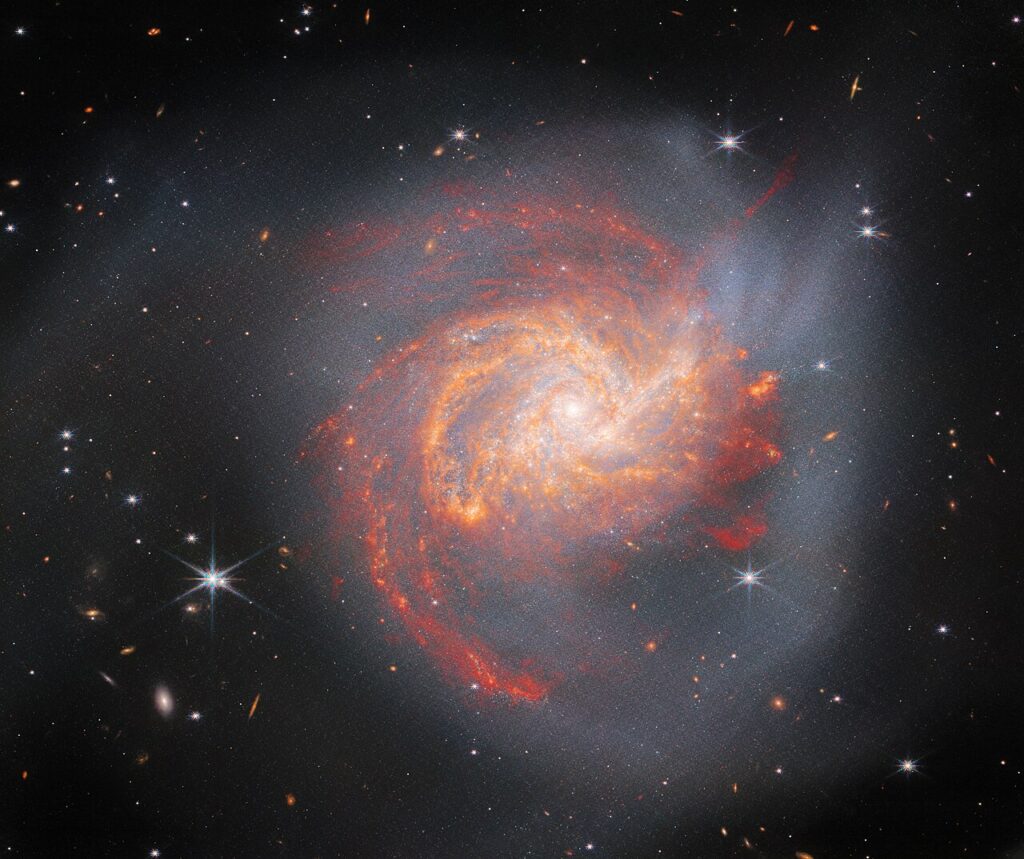
Space photography has given humanity something extraordinary: the ability to see the universe as it truly is. These images aren’t just beautiful—they’re windows into cosmic processes that have shaped galaxies, stars, and planets for billions of years. Each photograph tells a story about where we came from and what lies beyond our small world.
Let’s explore some of the most remarkable space images ever captured and uncover what they reveal about the cosmos.
The Pillars of Creation: Star Birth in Action
Captured by the Hubble Space Telescope in 1995 and reimaged by James Webb in 2022, the Pillars of Creation remain one of the most iconic space photographs ever taken. These towering columns of gas and dust in the Eagle Nebula stretch about 4 to 5 light-years tall—roughly the distance from our Sun to the nearest star.
What makes this image scientifically valuable is what it shows us about stellar birth. The pillars are slowly evaporating under intense ultraviolet radiation from nearby young stars, but they’re also actively forming new stars inside. The James Webb telescope’s infrared view pierced through the dust to reveal dozens of newborn stars previously hidden from view, appearing as bright red points throughout the structure.
These images remind us that star formation isn’t a relic of the ancient past—it’s happening right now, just 6,500 light-years away in our own galaxy.
Earthrise: Our Planet From the Moon
On December 24, 1968, Apollo 8 astronaut Bill Anders captured a photograph that changed how humanity sees itself. Earthrise shows our blue-and-white planet rising above the gray, barren lunar horizon—a fragile oasis suspended in the blackness of space.
The image revealed something no amount of description could convey: Earth’s isolation and vulnerability. There are no borders visible from space, no evidence of the conflicts that dominate our daily news. Just one small world, the only place in the universe we know for certain harbors life.
Nature photographer Galen Rowell later called it “the most influential environmental photograph ever taken,” and he wasn’t wrong. Earthrise helped spark the modern environmental movement and fundamentally shifted human perspective about our place in the cosmos.
The First Black Hole Image: Seeing the Unseeable
In April 2019, the Event Horizon Telescope collaboration released the first-ever photograph of a black hole—or more precisely, the shadow of its event horizon surrounded by a glowing ring of superheated matter. Located at the center of the galaxy M87, this black hole contains 6.5 billion times the mass of our Sun.
Creating this image required linking eight radio telescopes across the globe to form an Earth-sized virtual telescope. The result confirmed Einstein’s predictions about how extreme gravity warps spacetime. The asymmetry in the ring’s brightness even revealed the direction of the black hole’s rotation—the brighter side shows material moving toward us at nearly the speed of light.
In 2022, the same team released an image of Sagittarius A*, the supermassive black hole at the center of our own Milky Way galaxy, proving these cosmic monsters aren’t just distant curiosities—we orbit one ourselves.
The Hubble Deep Field: Galaxies Beyond Counting
In 1995, Hubble pointed at a tiny, apparently empty patch of sky no bigger than a grain of sand held at arm’s length and stared for ten consecutive days. The resulting Hubble Deep Field image revealed not emptiness but nearly 3,000 galaxies, each containing hundreds of billions of stars.
The Deep Field and its successors—the Hubble Ultra Deep Field and the more recent James Webb Deep Field—fundamentally changed our understanding of the universe’s scale. Nearly every point of light in these images is an entire galaxy. Many appear as they were billions of years ago, showing us what the young universe looked like when the first stars and galaxies were forming.
These images provided the first direct visual evidence that galaxies evolve over time, appearing smaller, bluer, and more irregular in the distant past than the massive spiral and elliptical galaxies we see nearby today.
Saturn From Cassini: Goodbye to a Giant
In 2017, as the Cassini spacecraft plunged into Saturn’s atmosphere at mission’s end, it sent back images from closer than any spacecraft had ever flown. But perhaps Cassini’s most emotionally powerful image came years earlier, in 2013: a backlit view of Saturn with Earth visible as a tiny blue dot in the distance, 898 million miles away.
The image shows Saturn’s rings in exquisite detail, lit from behind by the Sun, with the planet casting a shadow through its own ring system. It’s a humbling perspective—our entire world reduced to a single pixel in a photograph taken from the edge of the outer solar system.
Why These Images Matter
Space photographs do more than capture beauty—they expand human knowledge. They’ve revealed stellar nurseries, confirmed theoretical predictions, discovered new moons and rings, and shown us our planet as it really is: one small world in an unimaginably vast cosmos.
Every pixel in these images represents real photons that traveled across space, sometimes for billions of years, to reach our telescopes. They’re not artist’s concepts or illustrations—they’re evidence, data transformed into light we can see and understand.
Want to explore more cosmic wonders? Subscribe to the Love Space newsletter for one fascinating space idea delivered to your inbox every day.