
The International Space Station orbits Earth every 90 minutes at an altitude of roughly 250 miles, traveling at 17,500 miles per hour. That means astronauts aboard the ISS witness 16 sunrises and sunsets every single day. But what does daily life actually look like when you’re living in microgravity, 250 miles above the planet?
Life on the ISS is a carefully orchestrated balance of scientific research, station maintenance, exercise, and the surprisingly complex logistics of eating, sleeping, and staying clean in an environment where nothing stays put.
The Work Day: Science and Station Keeping
Astronauts typically work from around 7:30 AM to 7:30 PM Greenwich Mean Time, the standard schedule used aboard the ISS. Their days are planned down to five-minute increments by mission control teams on Earth, with schedules uploaded each morning.
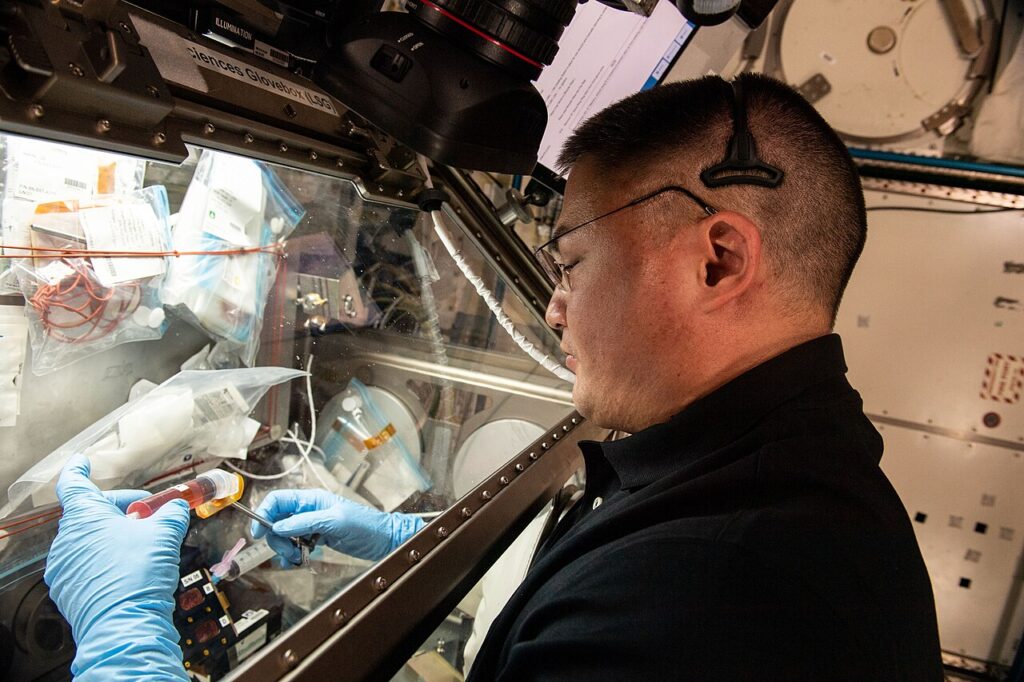
The bulk of an astronaut’s work day involves conducting experiments. The ISS serves as a unique laboratory where researchers study everything from protein crystal growth to combustion behavior in microgravity. Crew members might spend their morning tending to plant growth experiments in the Veggie system, their afternoon running materials science tests in the Columbus laboratory module, and their evening documenting results and transmitting data to Earth.
Station maintenance takes up a significant portion of each day. The ISS is a complex machine with over 50 computers, miles of wiring, and life support systems that require constant monitoring and repair. Astronauts regularly replace filters, update software, inspect equipment, and troubleshoot problems. When something breaks 250 miles from the nearest hardware store, the crew needs to fix it themselves.
Staying Healthy in Microgravity
Exercise isn’t optional on the ISS—it’s mandatory. Without Earth’s gravity to provide resistance, astronauts lose both muscle mass and bone density at an alarming rate. To counteract this, crew members exercise for about two hours every day using three main pieces of equipment:
- The ARED (Advanced Resistive Exercise Device), which simulates weightlifting using vacuum cylinders to create resistance
- The CEVIS (Cycle Ergometer with Vibration Isolation), essentially a stationary bike bolted to the station
- The T2 treadmill, where astronauts strap themselves down with harnesses to simulate running
Watching an astronaut run on the ISS treadmill is surreal—they’re essentially running on the ceiling or wall, held in place by bungee cords, while floating objects drift past them.
Eating, Sleeping, and Personal Time
Meals on the ISS have come a long way from the squeeze tubes of the Apollo era. Today’s astronauts enjoy a menu of over 200 items, from rehydratable macaroni and cheese to thermostabilized chicken teriyaki. Fresh fruit and vegetables arrive with resupply missions and are treasured treats. Crew members eat together when possible, using magnetic trays and Velcro to keep utensils and food pouches from floating away.
Sleep happens in small crew quarters, phone-booth-sized compartments with sleeping bags attached to the walls. Astronauts zip themselves in to avoid floating around and bumping into things during the night. Many cover the windows—otherwise, those 16 sunrises would make sleep impossible. Most crew members use earplugs and eye masks, as the station hums constantly with fans and equipment.
Personal time is limited but precious. Astronauts video call with family, read, watch movies, play musical instruments, and gaze out the cupola windows at Earth below. The cupola, a seven-window observatory module, is the station’s most popular spot during off-hours. Many astronauts say that watching Earth from space—seeing thunderstorms light up over Africa, the aurora dancing over the poles, or city lights twinkling in the darkness—never gets old.
The Weekend Routine
Saturdays are dedicated to housekeeping. Astronauts clean surfaces, organize supplies, collect and bag trash, and conduct routine inspections. They also have time for personal projects and catching up on email. Sundays offer more free time, though exercise and meals still structure the day.
One unique weekly task: the crew conference with mission control, where they discuss the upcoming week’s schedule, voice concerns, and coordinate with teams on the ground.
Hygiene in space requires creativity. There are no showers—astronauts use rinseless soap and damp towels to clean themselves. Hair washing involves applying water from a pouch, massaging in no-rinse shampoo, and toweling dry. Brushing teeth is similar to Earth, except you swallow the toothpaste or spit into a towel, since sinks don’t work in microgravity.
The toilet is perhaps the most complex piece of personal equipment on the station, using airflow to direct waste into the proper containers. Solid waste is stored and eventually burned up during a cargo vehicle’s reentry. Urine is recycled through the station’s life support system and converted back into drinking water—as astronauts often joke, yesterday’s coffee becomes tomorrow’s coffee.
Living on the ISS means adapting to an environment humans weren’t built for, where every everyday task requires rethinking. Yet astronauts consistently describe their time in space as the most meaningful experience of their lives—a chance to contribute to humanity’s future while floating above the world.
Want more insights into life beyond Earth? Subscribe to the Love Space newsletter and get one cosmic idea delivered to your inbox every day.