
The James Webb Space Telescope (JWST) has been peering into the depths of space for four years now, and the discoveries keep coming. Launched on December 25, 2021, and stationed nearly a million miles from Earth at the second Lagrange point (L2), Webb has fundamentally changed how we see the universe.
With its 6.5-meter gold-plated mirror and infrared vision, Webb can see through cosmic dust and capture light from galaxies formed just a few hundred million years after the Big Bang. Here’s what this remarkable observatory has shown us.
The Earliest Galaxies Ever Observed
One of Webb’s primary missions was to look back in time, and it has exceeded expectations. The telescope has identified galaxies that formed just 300 million years after the Big Bang—13.5 billion years ago. These ancient galaxies appear surprisingly bright and structured, challenging astronomers’ models of how quickly galaxies could form in the early universe.
In 2022, Webb captured the deepest infrared image of the universe ever taken, known as Webb’s First Deep Field. That single image contains thousands of galaxies, some of which had never been seen before. Since then, astronomers have used Webb to study the composition, structure, and evolution of these early galaxies, finding that some were forming stars far more rapidly than predicted.
These discoveries are forcing scientists to reconsider their understanding of cosmic evolution and the processes that shaped the first billion years of the universe.
Exoplanet Atmospheres in Unprecedented Detail
Webb has also revolutionized the study of exoplanets—planets orbiting stars beyond our solar system. Its infrared instruments can analyze the atmospheres of distant worlds by studying starlight as it passes through those atmospheres during transits.
The telescope has detected water vapor, carbon dioxide, methane, and other molecules in the atmospheres of several exoplanets. In 2022, Webb confirmed the presence of carbon dioxide in the atmosphere of WASP-39 b, a hot gas giant 700 light-years away—the first time CO2 had been definitively identified on a planet outside our solar system.
More recently, Webb has studied smaller, potentially rocky planets, searching for signs of atmospheres that might support life. While most findings so far involve large gas giants, the telescope’s capabilities give scientists hope that we’ll soon be able to characterize Earth-sized worlds in detail, particularly those in their star’s habitable zone.
Stunning Views of Star Birth and Death
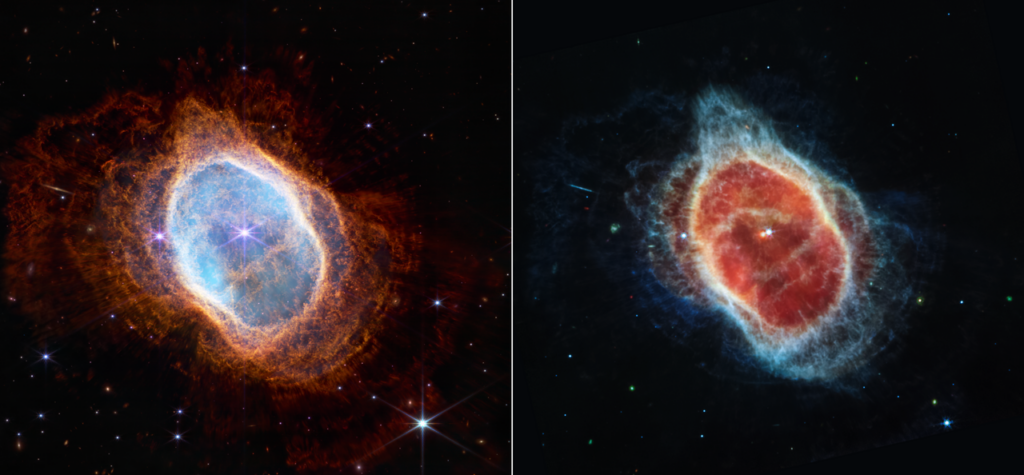
Some of Webb’s most visually spectacular images have come from its observations of stellar nurseries and dying stars. The telescope has captured breathtaking views of the Carina Nebula, the Pillars of Creation, and the Southern Ring Nebula, revealing structures and details invisible to previous observatories.
In the Pillars of Creation—iconic columns of gas and dust where new stars are forming—Webb’s infrared vision penetrated the obscuring dust to reveal dozens of newly forming stars that had never been seen before. These observations help astronomers understand how stars like our Sun are born and how planetary systems develop around them.
Webb has also observed supernova remnants and the environments around black holes, providing new insights into how stars die and how they enrich the universe with heavy elements necessary for planets and life.
Our Own Solar System in a New Light
While designed to study the distant universe, Webb has also turned its gaze closer to home. The telescope has captured remarkable images of Jupiter, revealing auroras, storms, and faint rings in unprecedented detail. It has studied Saturn’s rings and moons, observed Neptune’s atmosphere, and even tracked asteroids.
In 2023, Webb detected carbon dioxide on Europa, one of Jupiter’s moons, providing more evidence that this ice-covered world harbors a subsurface ocean that might support life. These observations complement data from missions like NASA’s Europa Clipper and help scientists plan future explorations of ocean worlds in our solar system.
What Comes Next
Webb is expected to operate for at least 20 years, and its mission is still in its early stages. Upcoming observations will focus on mapping the structure of dark matter, studying the supermassive black holes at the centers of galaxies, and continuing the search for potentially habitable worlds.
Every week brings new data from Webb, and astronomers around the world are analyzing the treasure trove of information it provides. The telescope has already transformed our understanding of the cosmos in just four years, and its best discoveries may still lie ahead.
Want to stay updated on the latest discoveries from Webb and other space missions? Subscribe to the Love Space newsletter and get one cosmic idea delivered to your inbox every day.